cp's OEIS Frontend

This is a front-end for the Online Encyclopedia of Integer Sequences, made by Christian Perfect. The idea is to provide OEIS entries in non-ancient HTML, and then to think about how they're presented visually. The source code is on GitHub.

Previous Showing 11-20 of 87 results. Next

A160425 a(n) = number of grid points that are covered after n-th rounds of A160120.

Original entry on oeis.org

0, 4, 10, 19, 31, 40
Offset: 0

Views

Author

Omar E. Pol, Jun 01 2009

Keywords

Crossrefs

A161426 Y-toothpick sequence starting at the outside corner of an infinite triangle-shaped polygon as the sieve of A160120 after 2^k rounds.

Original entry on oeis.org

0, 1, 4, 7, 14, 19, 26, 35, 52, 63, 70
Offset: 0

Views

Author

Omar E. Pol and David Applegate, Jun 20 2009

Keywords

Comments

The sequence gives the number of Y-toothpicks after n rounds. A161427 (the first differences) gives the number added at the n-th round.
See the entries A160120, A139250 and A153006 for more information.

Crossrefs

A299776 a(n) = 1 + 4*(A160120(n) - 1)/3.

Original entry on oeis.org

0, 1, 5, 9, 21, 25, 37, 49, 77, 89, 101, 113, 141, 161, 189, 225, 293, 329, 341, 353, 381, 401, 429, 465, 533, 577, 605, 641, 709, 777, 853, 945, 1101, 1209, 1237, 1249, 1277, 1297, 1325, 1361, 1429, 1473, 1501, 1537, 1605, 1673, 1749, 1841, 1997, 2113, 2157
Offset: 0

Views

Author

Omar E. Pol, Apr 03 2018

Keywords

Comments

Essentially this should be the 120-degree wedge of the cellular automaton of A160120 projected in four quadrants.
First differs from both A147552 and A160720 at a(9).

Crossrefs

A160789 Y-toothpick number A160120(n) minus toothpick number A139250(n).

Original entry on oeis.org

0, 0, 1, 0, 5, 4, 5, 2, 15, 20, 21
Offset: 0

Views

Author

Omar E. Pol, Jun 18 2009

Keywords

Crossrefs

Formula

a(n) = A160120(n)-A139250(n).

A162778 Partial sums of A160120.

Original entry on oeis.org

0, 1, 5, 12, 28, 47, 75, 112, 170, 237, 313, 398, 504, 625, 767, 936, 1156, 1403, 1659, 1924, 2210, 2511, 2833, 3182, 3582, 4015, 4469, 4950, 5482, 6065, 6705, 7414, 8240, 9147, 10075, 11012, 11970, 12943, 13937, 14958, 16030, 17135, 18261, 19414, 20618
Offset: 0

Views

Author

Omar E. Pol, Jul 16 2009

Keywords

Crossrefs

Extensions

Extended beyond a(16) by R. J. Mathar, Aug 01 2009

A139250 Toothpick sequence (see Comments lines for definition).

Original entry on oeis.org

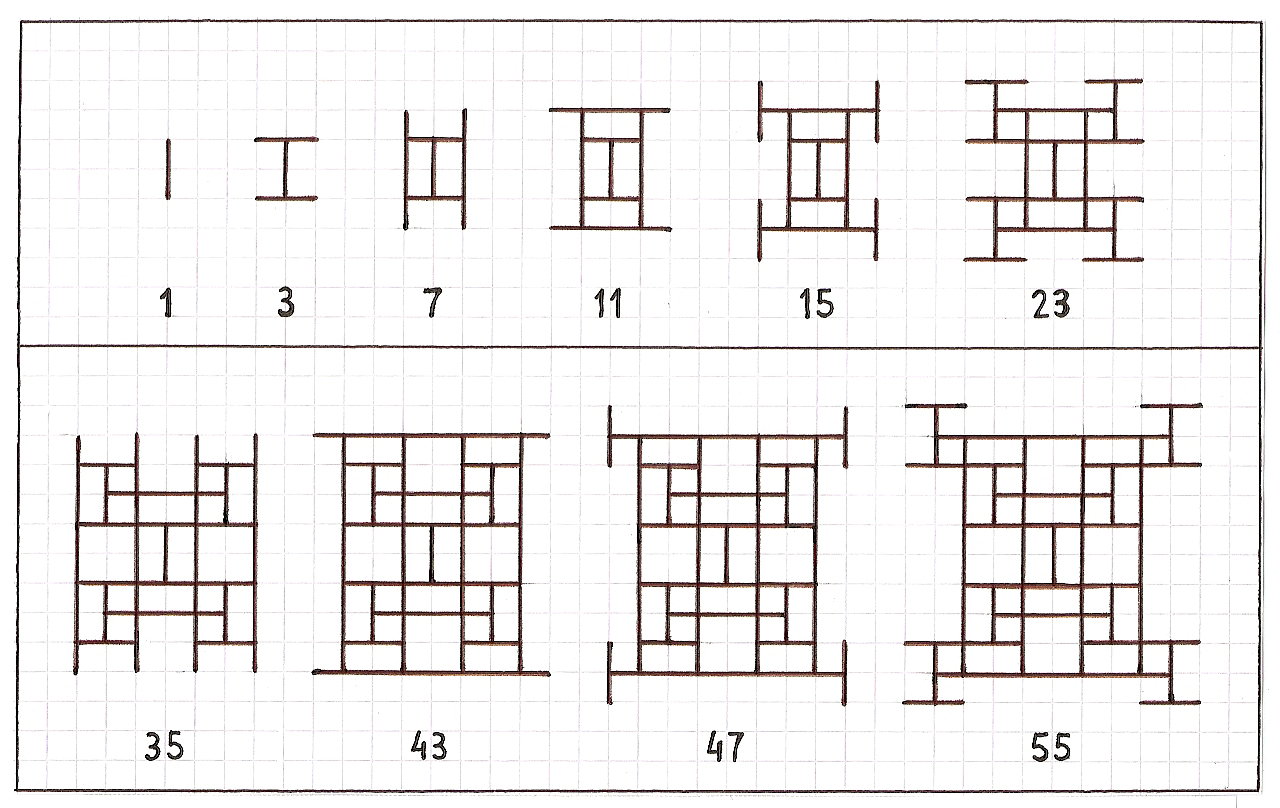
0, 1, 3, 7, 11, 15, 23, 35, 43, 47, 55, 67, 79, 95, 123, 155, 171, 175, 183, 195, 207, 223, 251, 283, 303, 319, 347, 383, 423, 483, 571, 651, 683, 687, 695, 707, 719, 735, 763, 795, 815, 831, 859, 895, 935, 995, 1083, 1163, 1199, 1215, 1243, 1279, 1319, 1379
Offset: 0

Views

Author

Omar E. Pol, Apr 24 2008

Keywords

Comments

A toothpick is a copy of the closed interval [-1,1]. (In the paper, we take it to be a copy of the unit interval [-1/2, 1/2].)
We start at stage 0 with no toothpicks.
At stage 1 we place a toothpick in the vertical direction, anywhere in the plane.
In general, given a configuration of toothpicks in the plane, at the next stage we add as many toothpicks as possible, subject to certain conditions:
- Each new toothpick must lie in the horizontal or vertical directions.
- Two toothpicks may never cross.
- Each new toothpick must have its midpoint touching the endpoint of exactly one existing toothpick.
The sequence gives the number of toothpicks after n stages. A139251 (the first differences) gives the number added at the n-th stage.
Call the endpoint of a toothpick "exposed" if it does not touch any other toothpick. The growth rule may be expressed as follows: at each stage, new toothpicks are placed so their midpoints touch every exposed endpoint.
This is equivalent to a two-dimensional cellular automaton. The animations show the fractal-like behavior.
After 2^k - 1 steps, there are 2^k exposed endpoints, all located on two lines perpendicular to the initial toothpick. At the next step, 2^k toothpicks are placed on these lines, leaving only 4 exposed endpoints, located at the corners of a square with side length 2^(k-1) times the length of a toothpick. - M. F. Hasler, Apr 14 2009 and others. For proof, see the Applegate-Pol-Sloane paper.
If the third condition in the definition is changed to "- Each new toothpick must have at exactly one of its endpoints touching the midpoint of an existing toothpick" then the same sequence is obtained. The configurations of toothpicks are of course different from those in the present sequence. But if we start with the configurations of the present sequence, rotate each toothpick a quarter-turn, and then rotate the whole configuration a quarter-turn, we obtain the other configuration.
If the third condition in the definition is changed to "- Each new toothpick must have at least one of its endpoints touching the midpoint of an existing toothpick" then the sequence n^2 - n + 1 is obtained, because there are no holes left in the grid.
A "toothpick" of length 2 can be regarded as a polyedge with 2 components, both on the same line. At stage n, the toothpick structure is a polyedge with 2*a(n) components.
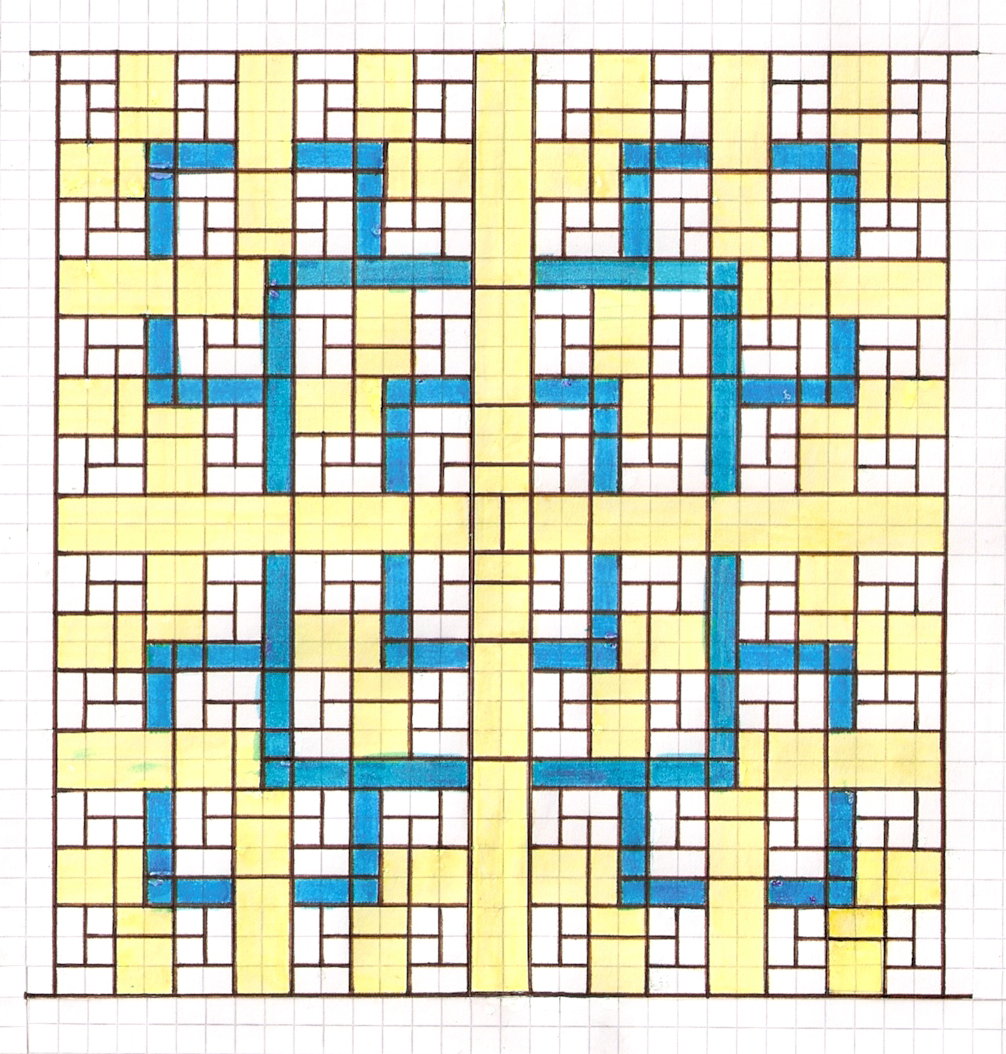
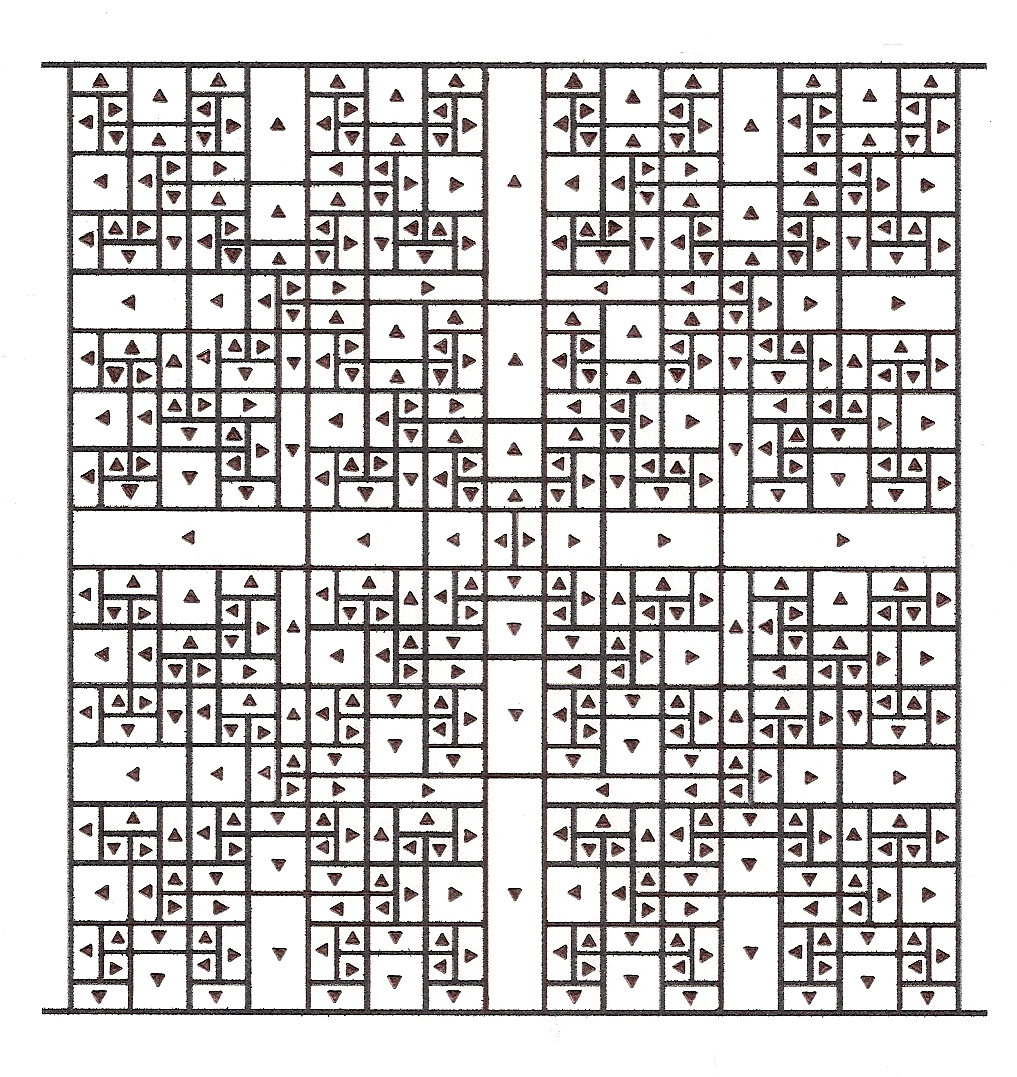
Conjecture: Consider the rectangles in the sieve (including the squares). The area of each rectangle (A = b*c) and the edges (b and c) are powers of 2, but at least one of the edges (b or c) is <= 2.
In the toothpick structure, if n >> 1, we can see some patterns that look like "canals" and "diffraction patterns". For example, see the Applegate link "A139250: the movie version", then enter n=1008 and click "Update". See also "T-square (fractal)" in the Links section. - Omar E. Pol, May 19 2009, Oct 01 2011
From Benoit Jubin, May 20 2009: The web page "Gallery" of Chris Moore (see link) has some nice pictures that are somewhat similar to the pictures of the present sequence. What sequences do they correspond to?
For a connection to Sierpiński triangle and Gould's sequence A001316, see the leftist toothpick triangle A151566.
Eric Rowland comments on Mar 15 2010 that this toothpick structure can be represented as a 5-state CA on the square grid. On Mar 18 2010, David Applegate showed that three states are enough. See links.
Equals row sums of triangle A160570 starting with offset 1; equivalent to convolving A160552: (1, 1, 3, 1, 3, 5, 7, ...) with (1, 2, 2, 2, ...). Equals A160762: (1, 0, 2, -2, 2, 2, 2, -6, ...) convolved with 2*n - 1: (1, 3, 5, 7, ...). Starting with offset 1 equals A151548: [1, 3, 5, 7, 5, 11, 17, 15, ...] convolved with A078008 signed (A151575): [1, 0, 2, -2, 6, -10, 22, -42, 86, -170, 342, ...]. - Gary W. Adamson, May 19 2009, May 25 2009
For a three-dimensional version of the toothpick structure, see A160160. - Omar E. Pol, Dec 06 2009
From Omar E. Pol, May 20 2010: (Start)
Observation about the arrangement of rectangles:
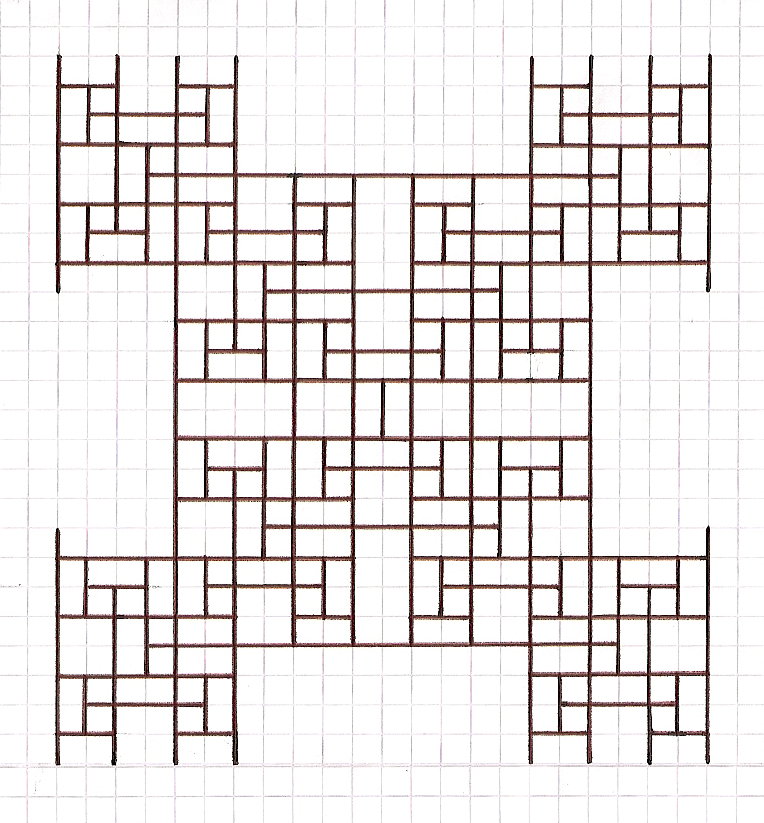
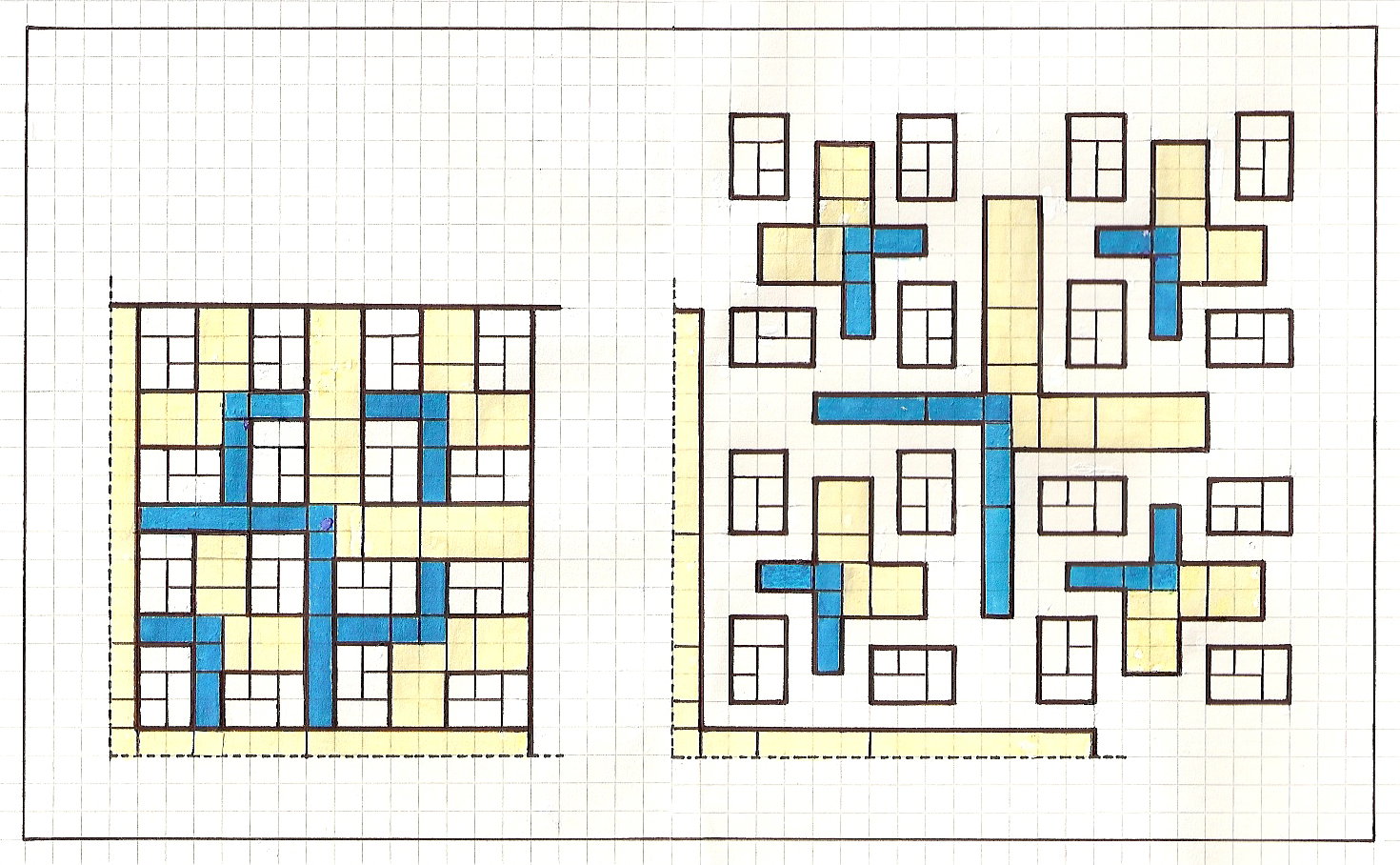
It appears there is a nice pattern formed by distinct modular substructures: a central cross surrounded by asymmetrical crosses (or "hidden crosses") of distinct sizes and also by "nuclei" of crosses.
Conjectures: after 2^k stages, for k >= 2, and for m = 1 to k - 1, there are 4^(m-1) substructures of size s = k - m, where every substructure has 4*s rectangles. The total number of substructures is equal to (4^(k-1)-1)/3 = A002450(k-1). For example: If k = 5 (after 32 stages) we can see that:
a) There is a central cross, of size 4, with 16 rectangles.
b) There are four hidden crosses, of size 3, where every cross has 12 rectangles.
c) There are 16 hidden crosses, of size 2, where every cross has 8 rectangles.
d) There are 64 nuclei of crosses, of size 1, where every nucleus has 4 rectangles.
Hence the total number of substructures after 32 stages is equal to 85. Note that in every arm of every substructure, in the potential growth direction, the length of the rectangles are the powers of 2. (See illustrations in the links. See also A160124.) (End)
It appears that the number of grid points that are covered after n-th stage of the toothpick structure, assuming the toothpicks have length 2*k, is equal to (2*k-2)*a(n) + A147614(n), k > 0. See the formulas of A160420 and A160422. - Omar E. Pol, Nov 13 2010
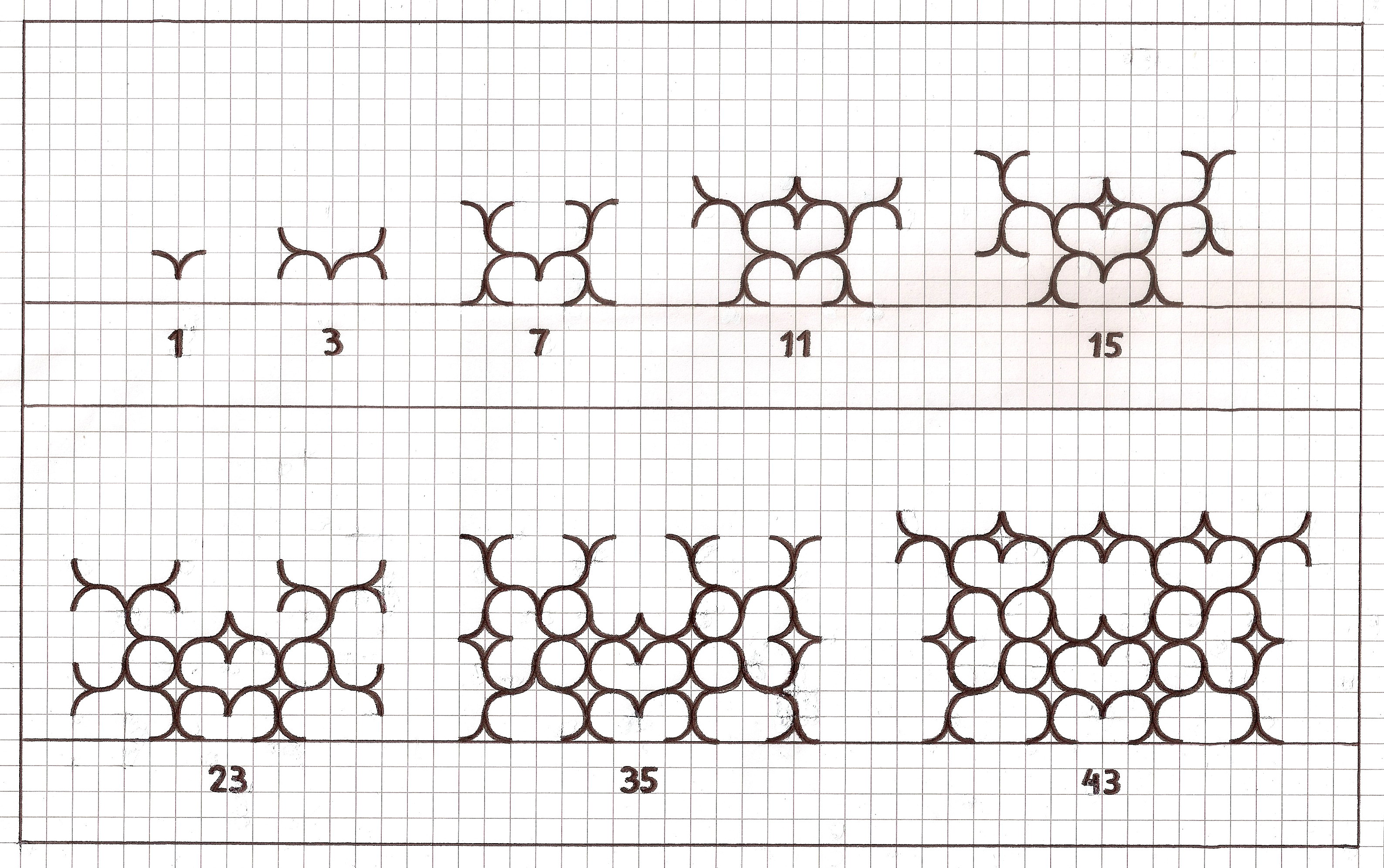
Version "Gullwing": on the semi-infinite square grid, at stage 1, we place a horizontal "gull" with its vertices at [(-1, 2), (0, 1), (1, 2)]. At stage 2, we place two vertical gulls. At stage 3, we place four horizontal gulls. a(n) is also the number of gulls after n-th stage. For more information about the growth of gulls see A187220. - Omar E. Pol, Mar 10 2011
From Omar E. Pol, Mar 12 2011: (Start)
Version "I-toothpick": we define an "I-toothpick" to consist of two connected toothpicks, as a bar of length 2. An I-toothpick with length 2 is formed by two toothpicks with length 1. The midpoint of an I-toothpick is touched by its two toothpicks. a(n) is also the number of I-toothpicks after n-th stage in the I-toothpick structure. The I-toothpick structure is essentially the original toothpick structure in which every toothpick is replaced by an I-toothpick. Note that in the physical model of the original toothpick structure the midpoint of a wooden toothpick of the new generation is superimposed on the endpoint of a wooden toothpick of the old generation. However, in the physical model of the I-toothpick structure the wooden toothpicks are not overlapping because all wooden toothpicks are connected by their endpoints. For the number of toothpicks in the I-toothpick structure see A160164 which also gives the number of gullwing in a gullwing structure because the gullwing structure of A160164 is equivalent to the I-toothpick structure. It also appears that the gullwing sequence A187220 is a supersequence of the original toothpick sequence A139250 (this sequence).
For the connection with the Ulam-Warburton cellular automaton see the Applegate-Pol-Sloane paper and see also A160164 and A187220.
(End)
A version in which the toothpicks are connected by their endpoints: on the semi-infinite square grid, at stage 1, we place a vertical toothpick of length 1 from (0, 0). At stage 2, we place two horizontal toothpicks from (0,1), and so on. The arrangement looks like half of the I-toothpick structure. a(n) is also the number of toothpicks after the n-th. - Omar E. Pol, Mar 13 2011
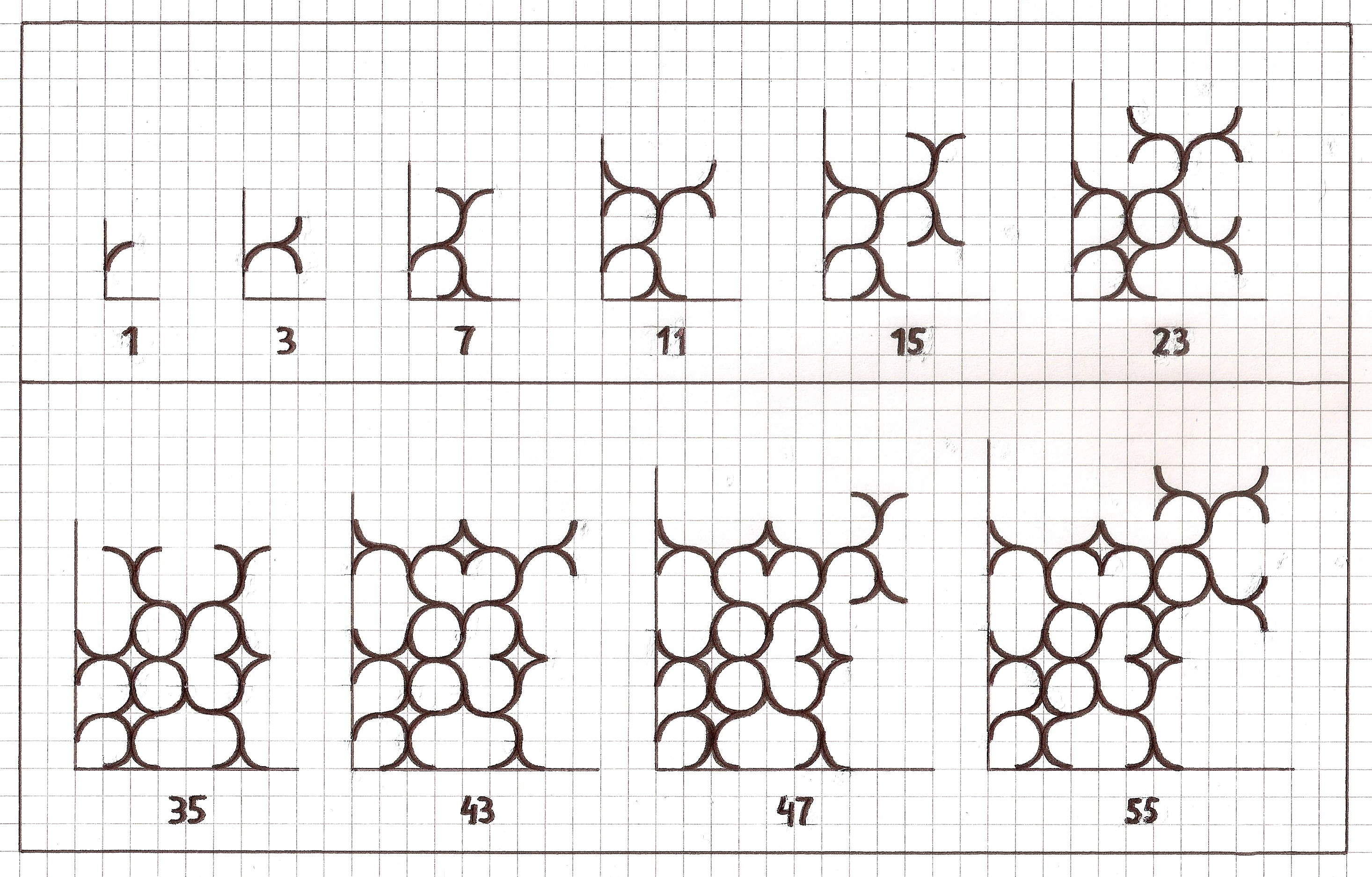
Version "Quarter-circle" (or Q-toothpick): a(n) is also the number of Q-toothpicks after the n-th stage in a Q-toothpick structure in the first quadrant. We start from (0,1) with the first Q-toothpick centered at (1, 1). The structure is asymmetric. For a similar structure but starting from (0, 0) see A187212. See A187210 and A187220 for more information. - Omar E. Pol, Mar 22 2011
Version "Tree": It appears that a(n) is also the number of toothpicks after the n-th stage in a toothpick structure constructed following a special rule: the toothpicks of the new generation have length 4 when they are placed on the infinite square grid (note that every toothpick has four components of length 1), but after every stage, one (or two) of the four components of every toothpick of the new generation is removed, if such component contains an endpoint of the toothpick and if such endpoint is touching the midpoint or the endpoint of another toothpick. The truncated endpoints of the toothpicks remain exposed forever. Note that there are three sizes of toothpicks in the structure: toothpicks of lengths 4, 3 and 2. A159795 gives the total number of components in the structure after the n-th stage. A153006 (the corner sequence of the original version) gives 1/4 of the total of components in the structure after the n-th stage. - Omar E. Pol, Oct 24 2011
From Omar E. Pol, Sep 16 2012: (Start)
It appears that a(n)/A147614(n) converges to 3/4.
It appears that a(n)/A160124(n) converges to 3/2.
It appears that a(n)/A139252(n) converges to 3.
Also:
It appears that A147614(n)/A160124(n) converges to 2.
It appears that A160124(n)/A139252(n) converges to 2.
It appears that A147614(n)/A139252(n) converges to 4.
(End)
It appears that a(n) is also the total number of ON cells after n-th stage in a quadrant of the structure of the cellular automaton described in A169707 plus the total number of ON cells after n+1 stages in a quadrant of the mentioned structure, without its central cell. See the illustration of the NW-NE-SE-SW version in A169707. See also the connection between A160164 and A169707. - Omar E. Pol, Jul 26 2015
On the infinite Cairo pentagonal tiling consider the symmetric figure formed by two non-adjacent pentagons connected by a line segment joining two trivalent nodes. At stage 1 we start with one of these figures turned ON. The rule for the next stages is that the concave part of the figures of the new generation must be adjacent to the complementary convex part of the figures of the old generation. a(n) gives the number of figures that are ON in the structure after n-th stage. A160164(n) gives the number of ON cells in the structure after n-th stage. - Omar E. Pol, Mar 29 2018
From Omar E. Pol, Mar 06 2019: (Start)
The "word" of this sequence is "ab". For further information about the word of cellular automata see A296612.
Version "triangular grid": a(n) is also the total number of toothpicks of length 2 after n-th stage in the toothpick structure on the infinite triangular grid, if we use only two of the three axes. Otherwise, if we use the three axes, so we have the sequence A296510 which has word "abc".
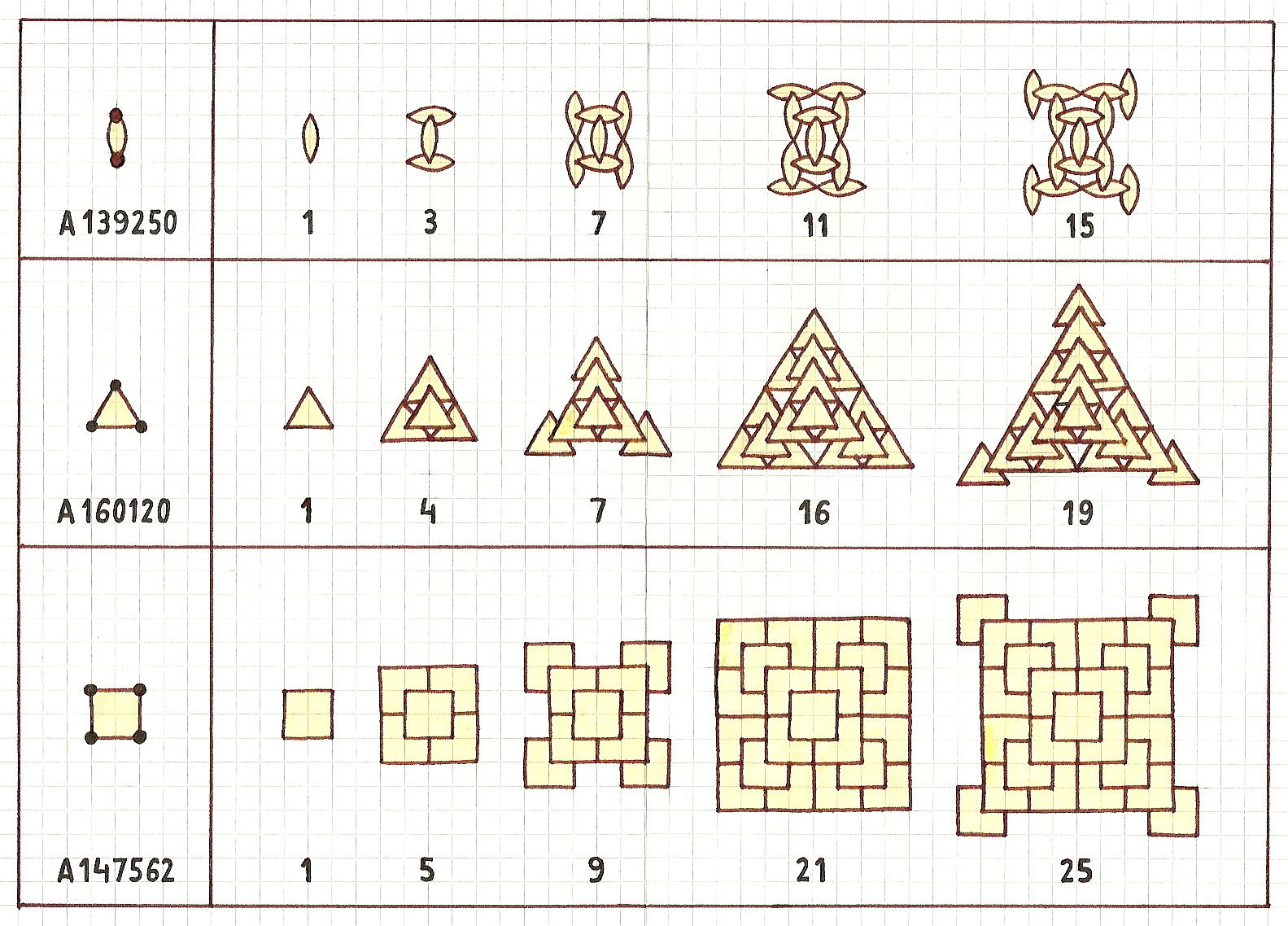
The normal toothpick structure can be considered a superstructure of the Ulam-Warburton celular automaton since A147562(n) equals here the total number of "hidden crosses" after 4*n stages, including the central cross (beginning to count the crosses when their "nuclei" are totally formed with 4 quadrilaterals). Note that every quadrilateral in the structure belongs to a "hidden cross".
Also, the number of "hidden crosses" after n stages equals the total number of "flowers with six petals" after n-th stage in the structure of A323650, which appears to be a "missing link" between this sequence and A147562.
Note that the location of the "nuclei of the hidden crosses" is very similar (essentially the same) to the location of the "flowers with six petals" in the structure of A323650 and to the location of the "ON" cells in the version "one-step bishop" of the Ulam-Warburton cellular automaton of A147562. (End)
From Omar E. Pol, Nov 27 2020: (Start)
The simplest substructures are the arms of the hidden crosses. Each closed region (square or rectangle) of the structure belongs to one of these arms. The narrow arms have regions of area 1, 2, 4, 8, ... The broad arms have regions of area 2, 4, 8, 16 , ... Note that after 2^k stages, with k >= 3, the narrow arms of the main hidden crosses in each quadrant frame the size of the toothpick structure after 2^(k-1) stages.
Another kind of substructure could be called "bar chart" or "bar graph". This substructure is formed by the rectangles and squares of width 2 that are adjacent to any of the four sides of the toothpick structure after 2^k stages, with k >= 2. The height of these successive regions gives the first 2^(k-1) - 1 terms from A006519. For example: if k = 5 the respective heights after 32 stages are [1, 2, 1, 4, 1, 2, 1, 8, 1, 2, 1, 4, 1, 2, 1]. The area of these successive regions gives the first 2^(k-1) - 1 terms of A171977. For example: if k = 5 the respective areas are [2, 4, 2, 8, 2, 4, 2, 16, 2, 4, 2, 8, 2, 4, 2].
For a connection to Mersenne primes (A000668) and perfect numbers (A000396) see A153006.
For a representation of the Wagstaff primes (A000979) using the toothpick structure see A194810.
For a connection to stained glass windows and a hidden curve see A336532. (End)
It appears that the graph of a(n) bears a striking resemblance to the cumulative distribution function F(x) for X the random variable taking values in [0,1], where the binary expansion of X is given by a sequence of independent coin tosses with probability 3/4 of being 1 at each bit. It appears that F(n/2^k)*(2^(2k+1)+1)/3 approaches a(n) for k large. - James Coe, Jan 10 2022

Examples

			a(10^10) = 52010594272060810683. - _David A. Corneth_, Mar 26 2015
		

References

  • D. Applegate, Omar E. Pol and N. J. A. Sloane, The Toothpick Sequence and Other Sequences from Cellular Automata, Congressus Numerantium, Vol. 206 (2010), 157-191
  • L. D. Pryor, The Inheritance of Inflorescence Characters in Eucalyptus, Proceedings of the Linnean Society of New South Wales, V. 79, (1954), p. 81, 83.
  • Richard P. Stanley, Enumerative Combinatorics, volume 1, second edition, chapter 1, exercise 95, figure 1.28, Cambridge University Press (2012), p. 120, 166.

Crossrefs

Programs

  • Maple
    G := (x/((1-x)*(1+2*x))) * (1 + 2*x*mul(1+x^(2^k-1)+2*x^(2^k),k=0..20)); # N. J. A. Sloane, May 20 2009, Jun 05 2009
    # From N. J. A. Sloane, Dec 25 2009: A139250 is T, A139251 is a.
    a:=[0,1,2,4]; T:=[0,1,3,7]; M:=10;
    for k from 1 to M do
    a:=[op(a),2^(k+1)];
    T:=[op(T),T[nops(T)]+a[nops(a)]];
    for j from 1 to 2^(k+1)-1 do
    a:=[op(a), 2*a[j+1]+a[j+2]];
    T:=[op(T),T[nops(T)]+a[nops(a)]];
    od: od: a; T;
  • Mathematica
    CoefficientList[ Series[ (x/((1 - x)*(1 + 2x))) (1 + 2x*Product[1 + x^(2^k - 1) + 2*x^(2^k), {k, 0, 20}]), {x, 0, 53}], x] (* Robert G. Wilson v, Dec 06 2010 *)
    a[0] = 0; a[n_] := a[n] = Module[{m, k}, m = 2^(Length[IntegerDigits[n, 2]] - 1); k = (2m^2+1)/3; If[n == m, k, k + 2 a[n - m] + a[n - m + 1] - 1]]; Table[a[n], {n, 0, 100}] (* Jean-François Alcover, Oct 06 2018, after David A. Corneth *)
  • PARI
    A139250(n,print_all=0)={my(p=[], /* set of "used" points. Points are written as complex numbers, c=x+iy. Toothpicks are of length 2 */
    ee=[[0,1]], /* list of (exposed) endpoints. Exposed endpoints are listed as [c,d] where c=x+iy is the position of the endpoint, and d (unimodular) is the direction */
    c,d,ne, cnt=1); print_all && print1("0,1"); n<2 && return(n);
    for(i=2,n, p=setunion(p, Set(Mat(ee~)[,1])); /* add endpoints (discard directions) from last move to "used" points */
    ne=[]; /* new (exposed) endpoints */
    for( k=1, #ee, /* add endpoints of new toothpicks if not among the used points */
    setsearch(p, c=ee[k][1]+d=ee[k][2]*I) || ne=setunion(ne,Set([[c,d]]));
    setsearch(p, c-2*d) || ne=setunion(ne,Set([[c-2*d,-d]]));
    ); /* using Set() we have the points sorted, so it's easy to remove those which finally are not exposed because they touch a new toothpick */
    forstep( k=#ee=eval(ne), 2, -1, ee[k][1]==ee[k-1][1] && k-- && ee=vecextract(ee,Str("^"k"..",k+1)));
    cnt+=#ee; /* each exposed endpoint will give a new toothpick */
    print_all && print1(","cnt));cnt} \\ M. F. Hasler, Apr 14 2009
    
  • PARI
    \\works for n > 0
    a(n) = {my(k = (2*msb(n)^2 + 1) / 3); if(n==msb(n),k , k + 2*a(n-msb(n)) + a(n - msb(n) + 1) - 1)}
    msb(n)=my(t=0);while(n>>t>0,t++);2^(t-1)\\ David A. Corneth, Mar 26 2015
    
  • Python
    def msb(n):
        t = 0
        while n>>t > 0:
            t += 1
        return 2**(t - 1)
    def a(n):
        k = (2 * msb(n)**2 + 1) / 3
        return 0 if n == 0 else k if n == msb(n) else k + 2*a(n - msb(n)) + a(n - msb(n) + 1) - 1
    [a(n) for n in range(101)]  # Indranil Ghosh, Jul 01 2017, after David A. Corneth's PARI script

Formula

a(2^k) = A007583(k), if k >= 0.
a(2^k-1) = A006095(k+1), if k >= 1.
a(A000225(k)) - a((A000225(k)-1)/2) = A006516(k), if k >= 1.
a(A000668(k)) - a((A000668(k)-1)/2) = A000396(k), if k >= 1.
G.f.: (x/((1-x)*(1+2*x))) * (1 + 2*x*Product_{k>=0} (1 + x^(2^k-1) + 2*x^(2^k))). - N. J. A. Sloane, May 20 2009, Jun 05 2009
One can show that lim sup a(n)/n^2 = 2/3, and it appears that lim inf a(n)/n^2 is 0.451... - Benoit Jubin, Apr 15 2009 and Jan 29 2010, N. J. A. Sloane, Jan 29 2010
Observation: a(n) == 3 (mod 4) for n >= 2. - Jaume Oliver Lafont, Feb 05 2009
a(2^k-1) = A000969(2^k-2), if k >= 1. - Omar E. Pol, Feb 13 2010
It appears that a(n) = (A187220(n+1) - 1)/2. - Omar E. Pol, Mar 08 2011
a(n) = 4*A153000(n-2) + 3, if n >= 2. - Omar E. Pol, Oct 01 2011
It appears that a(n) = A160552(n) + (A169707(n) - 1)/2, n >= 1. - Omar E. Pol, Feb 15 2015
It appears that a(n) = A255747(n) + A255747(n-1), n >= 1. - Omar E. Pol, Mar 16 2015
Let n = msb(n) + j where msb(n) = A053644(n) and let a(0) = 0. Then a(n) = (2 * msb(n)^2 + 1)/3 + 2 * a(j) + a(j+1) - 1. - David A. Corneth, Mar 26 2015
It appears that a(n) = (A169707(n) - 1)/4 + (A169707(n+1) - 1)/4, n >= 1. - Omar E. Pol, Jul 24 2015

Extensions

Verified and extended, a(49)-a(53), using the given PARI code by M. F. Hasler, Apr 14 2009
Further edited by N. J. A. Sloane, Jan 28 2010

A147562 Number of "ON" cells at n-th stage in the "Ulam-Warburton" two-dimensional cellular automaton.

Original entry on oeis.org

0, 1, 5, 9, 21, 25, 37, 49, 85, 89, 101, 113, 149, 161, 197, 233, 341, 345, 357, 369, 405, 417, 453, 489, 597, 609, 645, 681, 789, 825, 933, 1041, 1365, 1369, 1381, 1393, 1429, 1441, 1477, 1513, 1621, 1633, 1669, 1705, 1813, 1849, 1957, 2065, 2389, 2401, 2437, 2473
Offset: 0

Views

Author

N. J. A. Sloane, based on emails from Franklin T. Adams-Watters, R. J. Mathar and David W. Wilson, Apr 29 2009

Keywords

Comments

Studied by Holladay and Ulam circa 1960. See Fig. 1 and Example 1 of the Ulam reference. - N. J. A. Sloane, Aug 02 2009.
Singmaster calls this the Ulam-Warburton cellular automaton. - N. J. A. Sloane, Aug 05 2009
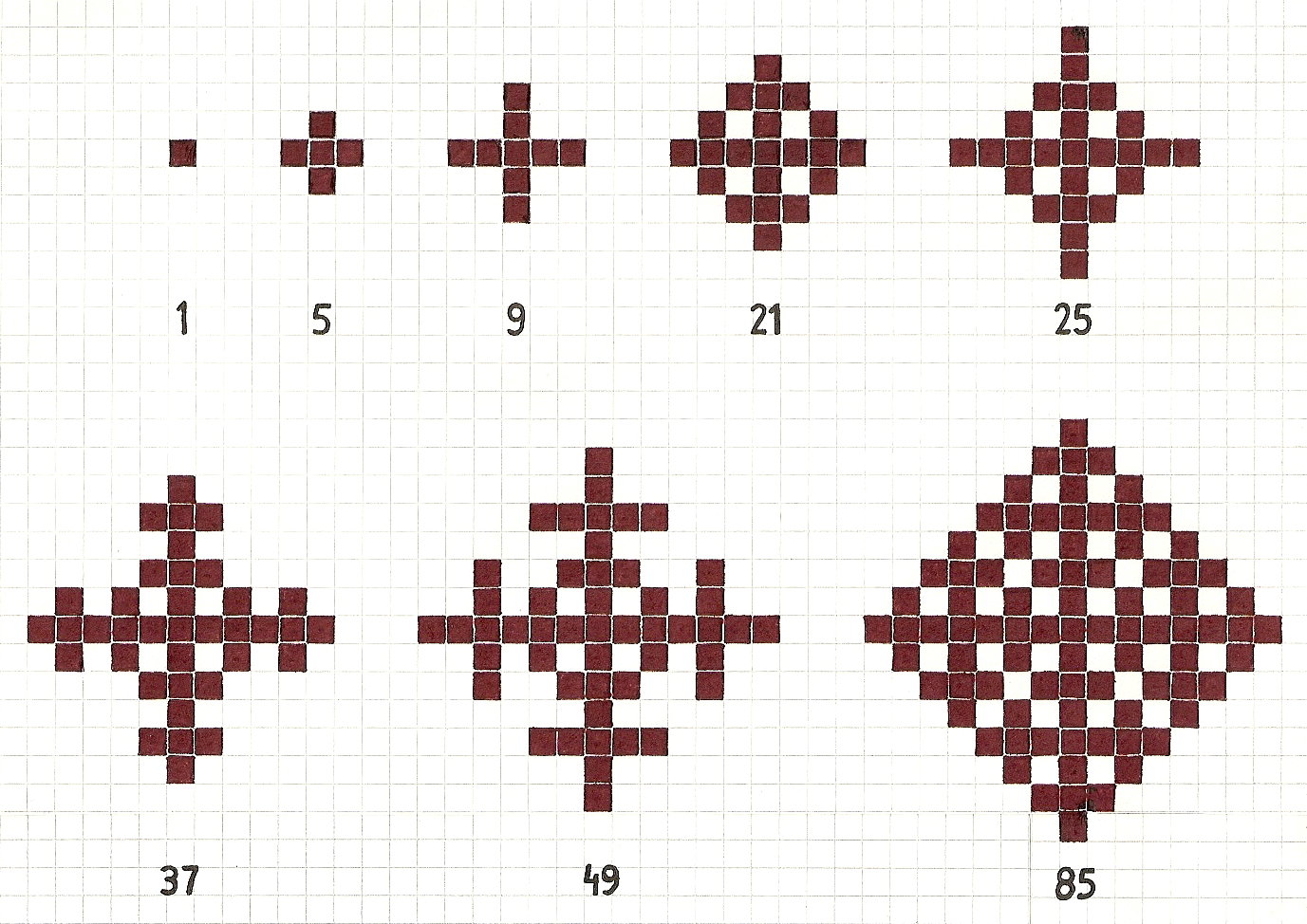
On the infinite square grid, start with all cells OFF.
Turn a single cell to the ON state.
At each subsequent step, each cell with exactly one neighbor ON is turned ON, and everything that is already ON remains ON.
Here "neighbor" refers to the four adjacent cells in the X and Y directions.
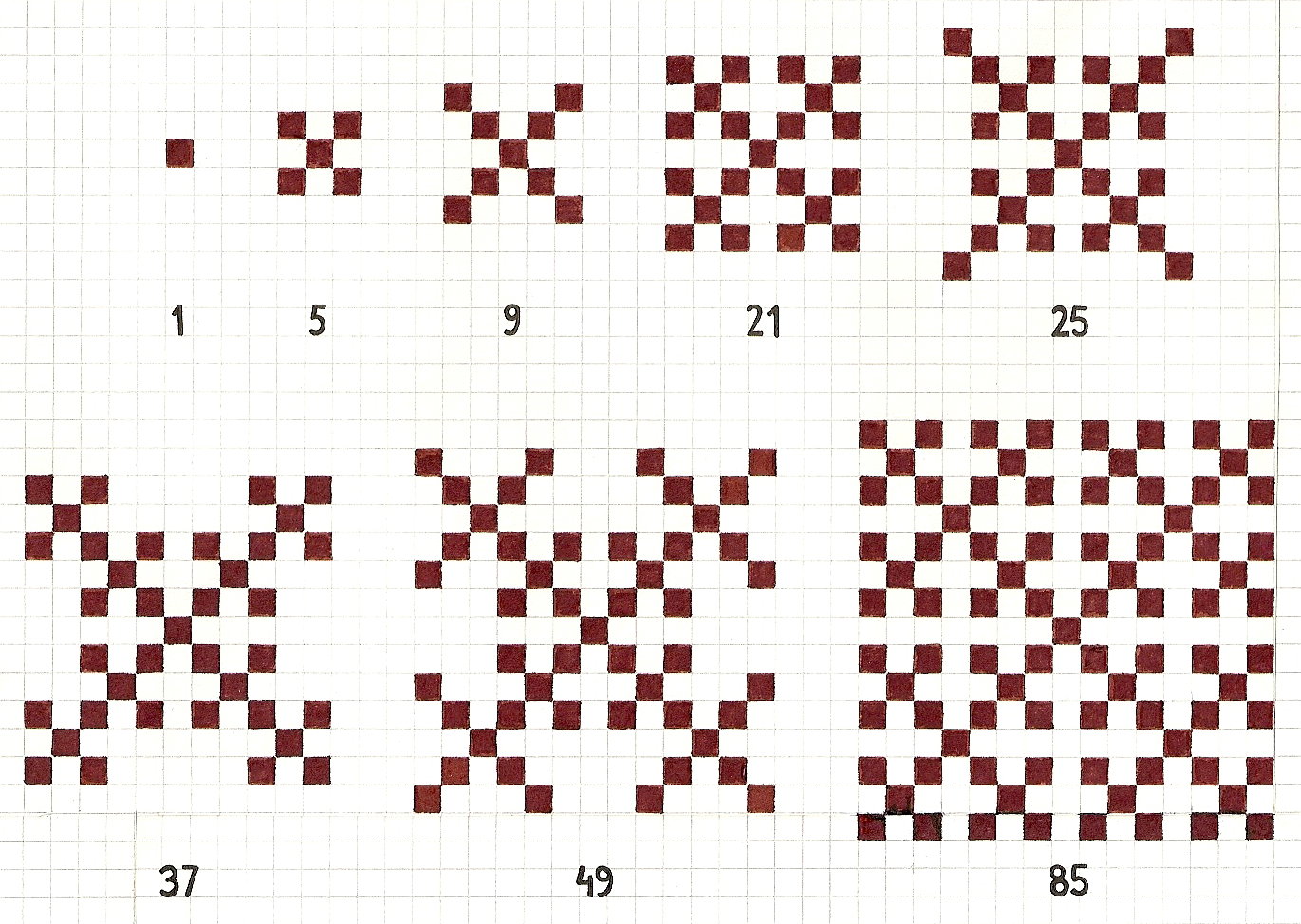
Note that "neighbor" could equally well refer to the four adjacent cells in the diagonal directions, since the graph formed by Z^2 with "one-step rook" adjacencies is isomorphic to Z^2 with "one-step bishop" adjacencies.
Also toothpick sequence starting with a central X-toothpick followed by T-toothpicks (see A160170 and A160172). The sequence gives the number of polytoothpicks in the structure after n-th stage. - Omar E. Pol, Mar 28 2011
It appears that this sequence shares infinitely many terms with both A162795 and A169707, see Formula section and Example section. - Omar E. Pol, Feb 20 2015
It appears that the positive terms are also the odd terms (a bisection) of A151920. - Omar E. Pol, Mar 06 2015
Also, the number of active (ON, black) cells in the n-th stage of growth of two-dimensional cellular automaton defined by Wolfram's "Rule 558" or "Rule 686" based on the 5-celled von Neumann neighborhood. - Robert Price, May 10 2016
From Omar E. Pol, Mar 05 2019: (Start)
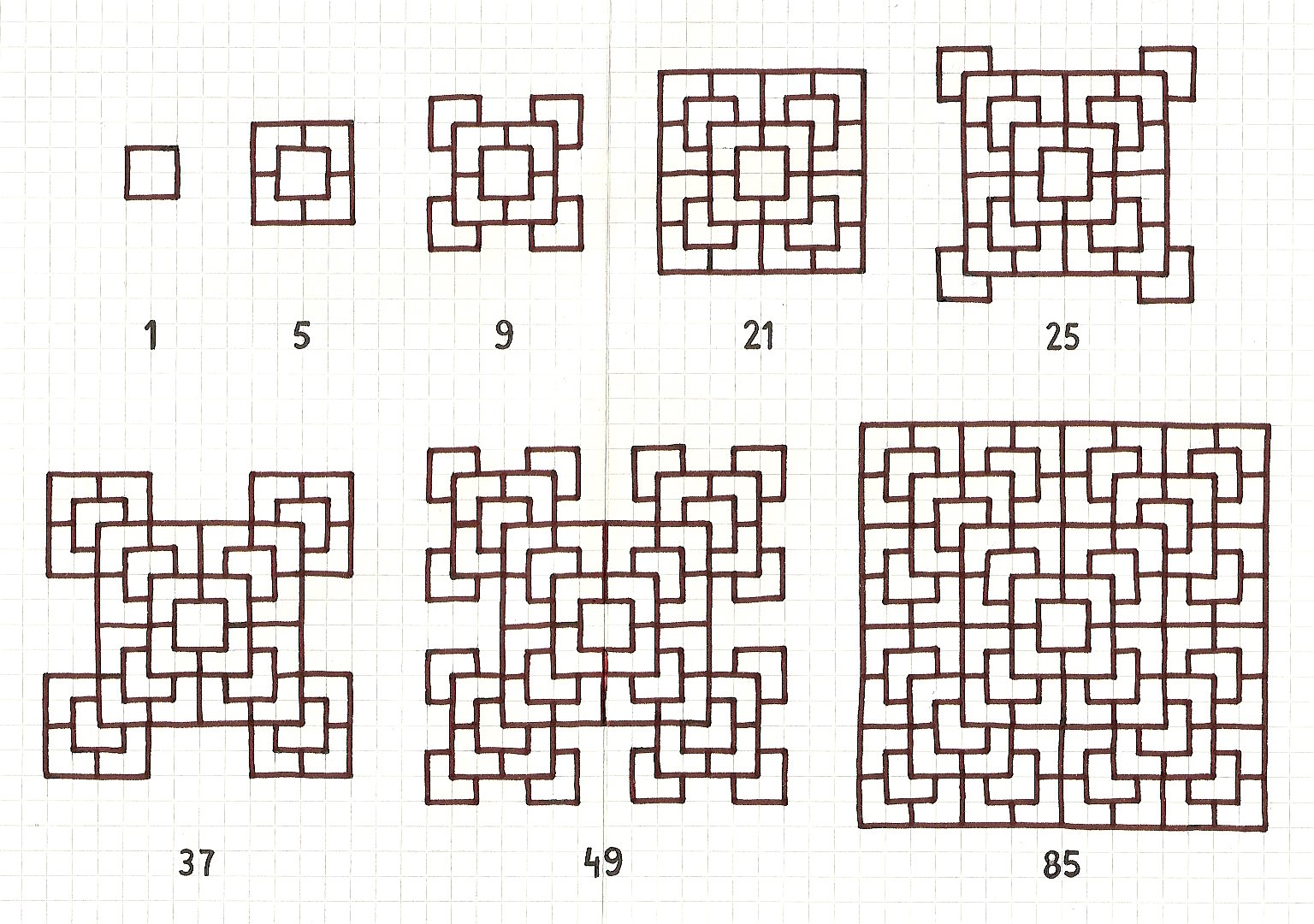
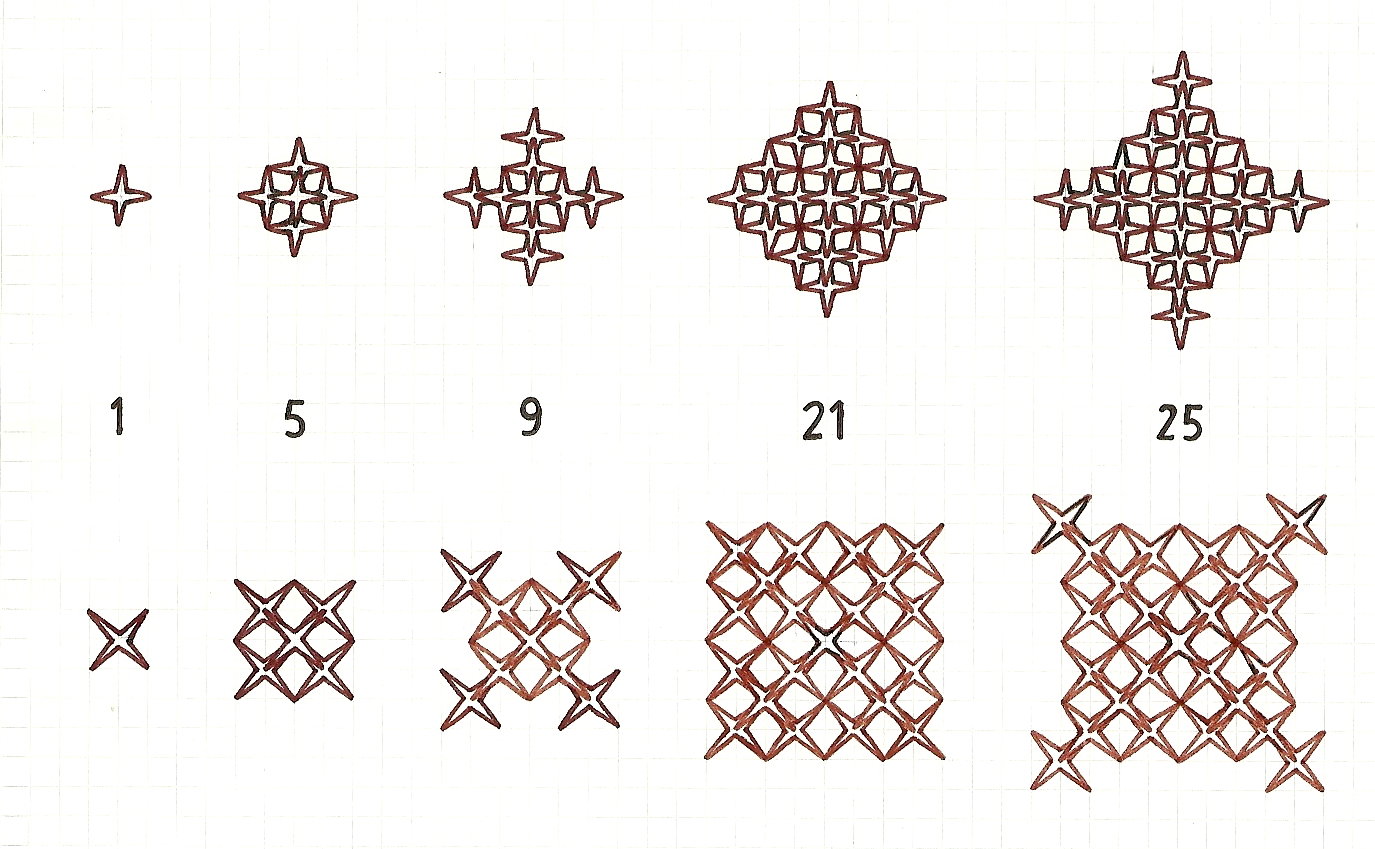
a(n) is also the total number of "hidden crosses" after 4*n stages in the toothpick structure of A139250, including the central cross, beginning to count the crosses when their nuclei are totally formed with 4 quadrilaterals.
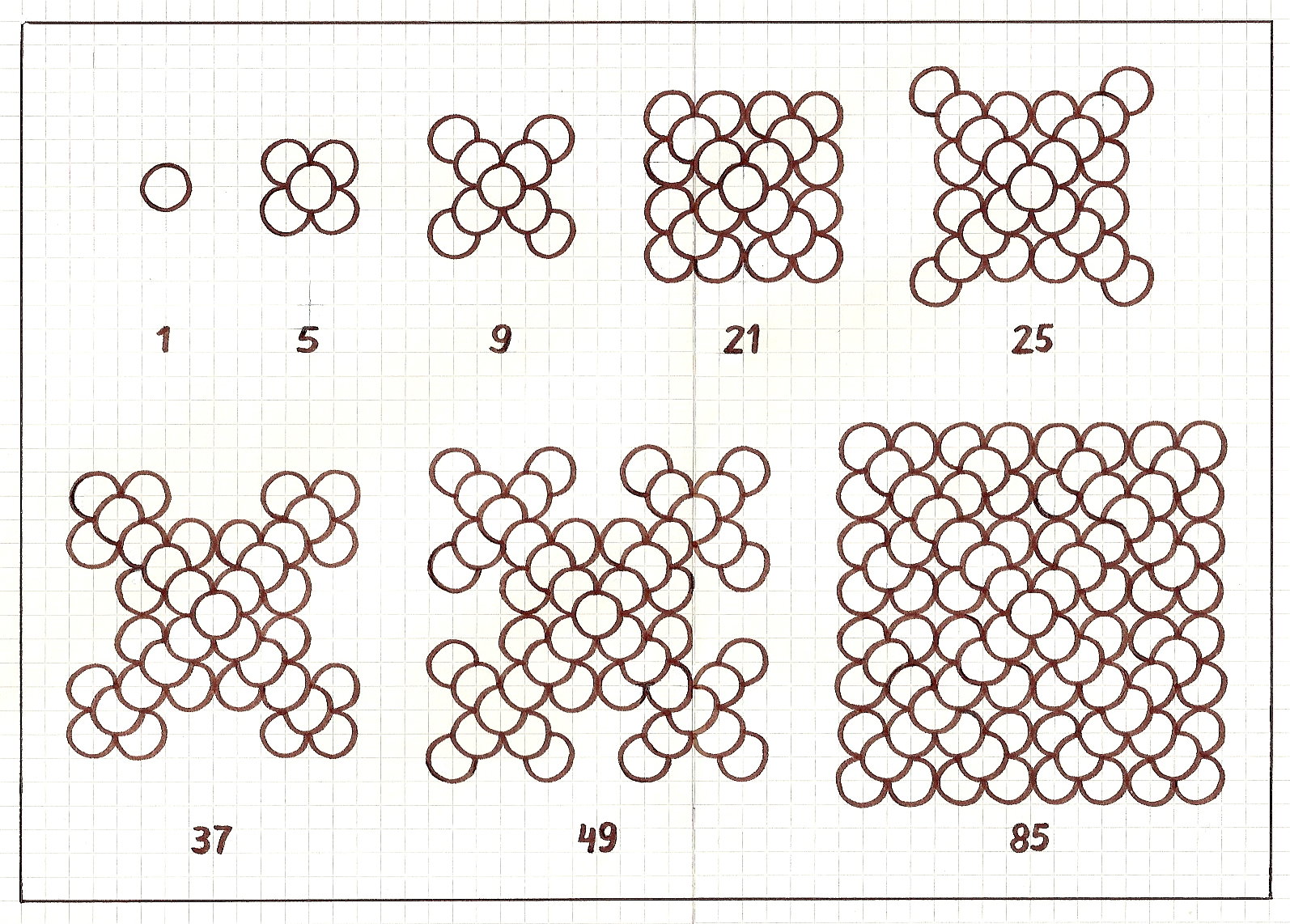
a(n) is also the total number of "flowers with six petals" after 4*n stages in the toothpick structure of A323650.
Note that the location of the "nuclei of the hidden crosses" and the "flowers with six petals" in both toothpick structures is essentially the same as the location of the "ON" cells in the version "one-step bishop" of this sequence (see the illustration of initial terms, figure 2). (End)
This sequence has almost exactly the same graph as A187220, A162795, A169707 and A160164 which is twice A139250. - Omar E. Pol, Jun 18 2022

Examples

			If we label the generations of cells turned ON by consecutive numbers we get a rosetta cell pattern:
. . . . . . . . . . . . . . . . .
. . . . . . . . 4 . . . . . . . .
. . . . . . . 4 3 4 . . . . . . .
. . . . . . 4 . 2 . 4 . . . . . .
. . . . . 4 3 2 1 2 3 4 . . . . .
. . . . . . 4 . 2 . 4 . . . . . .
. . . . . . . 4 3 4 . . . . . . .
. . . . . . . . 4 . . . . . . . .
. . . . . . . . . . . . . . . . .
In the first generation, only the central "1" is ON, a(1)=1. In the next generation, we turn ON four "2", leading to a(2)=a(1)+4=5. In the third generation, four "3" are turned ON, a(3)=a(2)+4=9. In the fourth generation, each of the four wings allows three 4's to be turned ON, a(4)=a(3)+4*3=21.
From _Omar E. Pol_, Feb 18 2015: (Start)
Also, written as an irregular triangle T(j,k), j>=0, k>=1, in which the row lengths are the terms of A011782:
1;
5;
9,   21;
25,  37, 49, 85;
89, 101,113,149,161,197,233,341;
345,357,369,405,417,453,489,597,609,645,681,789,825,933,1041,1365;
...
The right border gives the positive terms of A002450.
(End)
It appears that T(j,k) = A162795(j,k) = A169707(j,k), if k is a power of 2, for example: it appears that the three mentioned triangles only share the elements from the columns 1, 2, 4, 8, 16, ... - _Omar E. Pol_, Feb 20 2015
		

References

  • S. Ulam, On some mathematical problems connected with patterns of growth of figures, pp. 215-224 of R. E. Bellman, ed., Mathematical Problems in the Biological Sciences, Proc. Sympos. Applied Math., Vol. 14, Amer. Math. Soc., 1962.
  • S. Wolfram, A New Kind of Science, Wolfram Media, 2002; p. 928.

Crossrefs

Programs

  • Maple
    Since this is the partial sum sequence of A147582, it is most easily obtained using the Maple code given in A147582.
    # [x,y] coordinates of cells on
    Lse := [[0,0]] ;
    # enclosing rectangle of the cells on (that is, minima and maxima in Lse)
    xmin := 0 ;
    xmax := 0 ;
    ymin := 0 ;
    ymax := 0 ;
    # count neighbors of x,y which are on; return 0 if [x,y] is in L
    cntnei := proc(x,y,L)
    local a,p,xpt,ypt;
    a := 0 ;
    if not [x,y] in L then
    for p in Lse do
    xpt := op(1,p) ;
    ypt := op(2,p) ;
    if ( abs(xpt-x) = 1 and ypt=y ) or ( x=xpt and abs(ypt-y) = 1) then
    a := a+1 ;
    fi;
    od:
    fi:
    RETURN(a) ;
    end:
    # loop over generations/steps
    for stp from 1 to 10 do
    Lnew := [] ;
    for x from xmin-1 to xmax+1 do
    for y from ymin-1 to ymax+1 do
    if cntnei(x,y,Lse) = 1 then
    Lnew := [op(Lnew),[x,y]] ;
    fi;
    od:
    od:
    for p in Lnew do
    xpt := op(1,p) ;
    ypt := op(2,p) ;
    xmin := min(xmin,xpt) ;
    xmax := max(xmax,xpt) ;
    ymin := min(ymin,ypt) ;
    ymax := max(ymax,ypt) ;
    od:
    Lse := [op(Lse),op(Lnew)] ;
    print(nops(Lse)) ;
  • Mathematica
    Join[{0},Map[Function[Apply[Plus,Flatten[ #1]]],CellularAutomaton[{686,{2,{{0,2,0},{2,1,2},{0,2,0}}},{1,1}},{{{1}},0},200]]] (* Nadia Heninger and N. J. A. Sloane, Aug 11 2009; modified by Paolo Xausa, Aug 12 2022 to include the a(0) term *)
    ArrayPlot /@ CellularAutomaton[{686, {2, {{0, 2, 0}, {2, 1, 2}, {0, 2, 0}}}, {1, 1}}, {{{1}}, 0}, 16] (* N. J. A. Sloane, Nov 08 2014 *)
    A147562list[nmax_]:=Accumulate[Join[{0,1},4*3^(DigitCount[Range[nmax-1],2,1]-1)]];A147562list[100] (* Paolo Xausa, May 21 2023 *)
  • PARI
    a(n) = if (n, 1 + 4*sum(k=1, n-1, 3^(hammingweight(k)-1)), 0); \\ Michel Marcus, Jul 05 2022

Formula

a(n) = 1 + 4*Sum_{k=1..n-1} 3^(wt(k)-1) for n>1, where wt() = A000120(). [Corrected by Paolo Xausa, Aug 12 2022]
For asymptotics see the discussion in the comments in A006046. - N. J. A. Sloane, Mar 11 2021
From Omar E. Pol, Mar 13 2011: (Start)
a(n) = 2*A151917(n) - 1, for n >= 1.
a(n) = 1 + 4*A151920(n-2), for n >= 2.
(End)
It appears that a(n) = A162795(n) = A169707(n), if n is a member of A048645, otherwise a(n) < A162795(n) < A169707(n). - Omar E. Pol, Feb 20 2015
It appears that a(n) = A151920(2n-2), n >= 1. - Omar E. Pol, Mar 06 2015
It appears that a(n) = (A130665(2n-1) - 1)/3, n >= 1. - Omar E. Pol, Mar 07 2015
a(n) = 1 + 4*(A130665(n-1) - 1)/3, n >= 1. Omar E. Pol, Mar 07 2015
a(n) = A323650(2n)/3. - Omar E. Pol, Mar 04 2019

Extensions

Offset and initial terms changed by N. J. A. Sloane, Jun 07 2009
Numbers in the comment adapted to the offset by R. J. Mathar, Mar 03 2010

A194270 D-toothpick sequence of the second kind (see Comments lines for definition).

Original entry on oeis.org

0, 1, 5, 13, 29, 51, 75, 97, 137, 177, 209, 241, 297, 371, 467, 517, 605, 677, 709, 757, 829, 933, 1061, 1173, 1317, 1461, 1613, 1709, 1861, 2039, 2279, 2401, 2585, 2721, 2753, 2801, 2873, 2981, 3125, 3269, 3453, 3641, 3841, 4017, 4289, 4563, 4979, 5229
Offset: 0

Views

Author

Omar E. Pol, Aug 23 2011

Keywords

Comments

This is a cellular automaton of forking paths to 135 degrees which uses elements of two sizes: toothpicks of length 1 and D-toothpicks of length 2^(1/2). Toothpicks are placed in horizontal or vertical direction. D-toothpicks are placed in diagonal direction. Toothpicks and D-toothpicks are connected by their endpoints.
On the infinite square grid we start with no elements.
At stage 1, we place anywhere a D-toothpick.
The rule for adding new elements is as follows. Each exposed endpoint of the elements of the old generation must be touched by the two endpoints of two elements of the new generation such that the angle between the old element and each new element is equal to 135 degrees. Intersections and overlapping are prohibited, so some toothpick endpoints can remain exposed forever.
The sequence gives the number of toothpicks and D-toothpicks in the structure after n-th stage. The first differences (A194271) give the number of toothpicks and D-toothpicks added at n-th stage.
If n >> 1 the structure looks like an almost regular octagon. The structure has a fractal-like behavior related to powers of 2 (see formula section in A194271 and A194443). Note that for some values of n we can see an internal growth, similar to A160120. Also there are hidden substructures which have a surprising connection with the Sierpinski triangle. The hidden substructures are displayed more clearly for large values of n without reducing the scale of the drawing. The main "wedges" in the structures are essentially the triangles A194440 and A194442.
Note that this structure is much more complex than A139250 and A160120. The structure contains a large number of distinct polygonal shapes. There are convex polygons and concave polygons, also there are symmetrical and asymmetrical polygons. Several of these polygons are also in the structure of A172310. The number of edges of the known polygons are 3, 4, 5, 6, 7, 8, 9, 10, 11, 12, 13, 14, 16, 17, 20, 24. Is not known how many distinct types of polygons there are in the structure if n -> infinite. The sequences related with these polygons are A194276, A194277, A194278 and A194283. Note that the structure is not centered with respect to the axes X, Y. Also, for some polygons the area is not an integer. For symmetric versions of C. A. see A194432 and A194434.
Another representation (Large version): instead toothpicks of length 1 we place toothpicks of length 2. We start with no toothpicks. At stage 1, we place a toothpick of length 2 on the y-axis and centered at the origin. At stage 2 we place four D-toothpicks of length 2^(1/2) = sqrt(2), and so on. In this case the structure is centered with respect to the axes X, Y and the area of the polygons is an integer.
[It appears that a normal toothpick is a line segment of length 1 that is parallel to the x-axis or the y-axis. A D-toothpick is a line segment of length sqrt(2) with slope +-1. D stands for diagonal. - N. J. A. Sloane, Feb 06 2023]

Examples

			Illustration of initial terms:
.                                            o   o
.                                             \ /
.                        o                     o     o
.                        |                     |    /
.        o               o - o         o       o - o
.       /               /               \     /     \
.      o           o - o                 o - o       o
.                      |                /    |
.                      o               o     o
.                                           / \
.                                          o   o
.
.       1               5                    13
.
		

Crossrefs

Extensions

More terms from Omar E. Pol, Sep 01 2011

A161206 V-toothpick (or honeycomb) sequence (see Comments lines for definition).

Original entry on oeis.org

0, 1, 3, 7, 13, 21, 31, 43, 57, 69, 81, 99, 123, 153, 183, 211, 241, 261, 273, 291, 317, 351, 393, 443, 499, 553, 597, 645, 709, 791, 871, 939, 1005, 1041, 1053, 1071, 1097, 1131, 1173, 1223, 1281, 1339, 1393, 1459, 1549, 1663, 1789, 1911, 2031, 2133, 2193
Offset: 0

Views

Author

Omar E. Pol, Jun 08 2009

Keywords

Comments

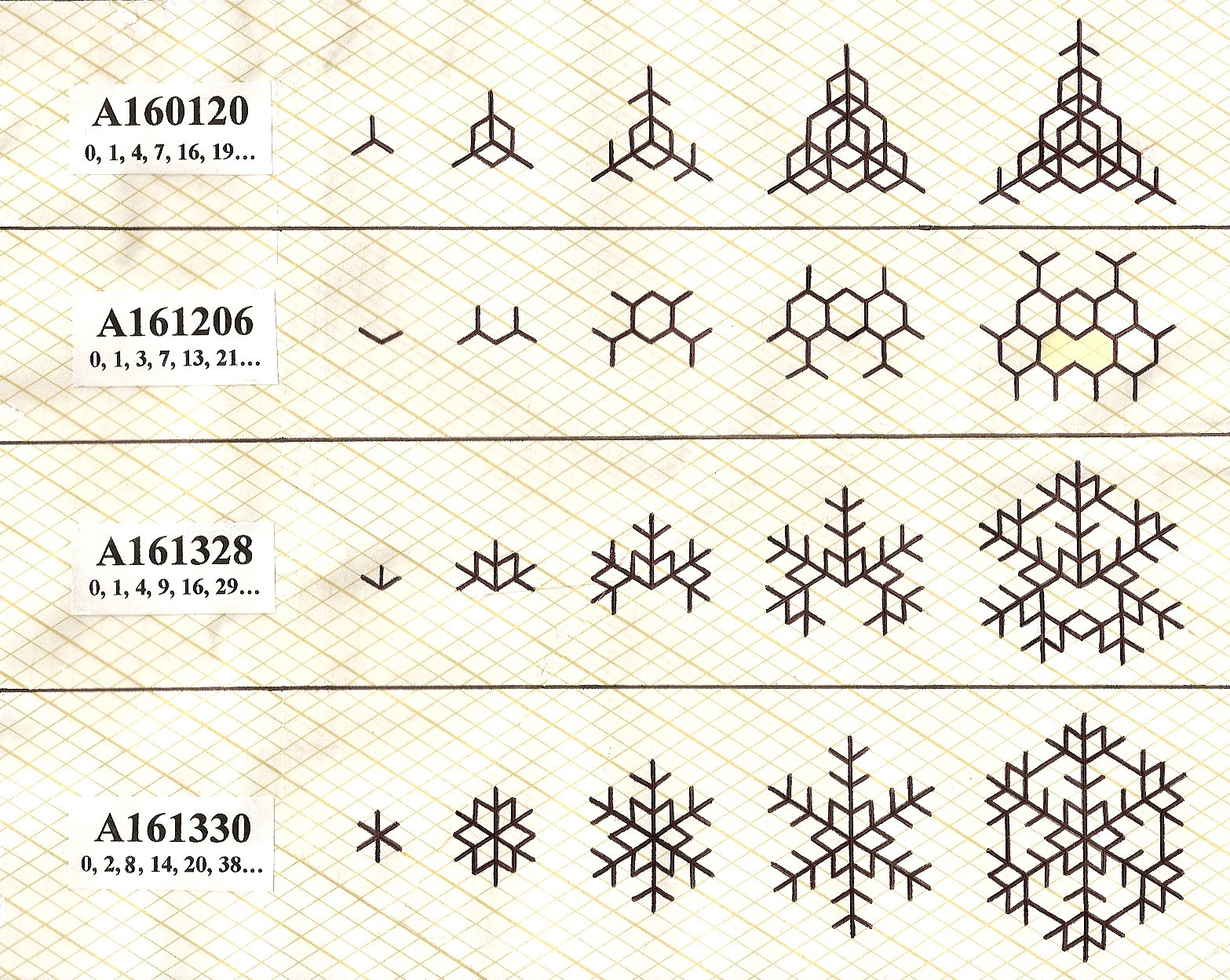
A V-toothpick is constructed from two toothpicks of length 1 with a 120-degree angle between them, forming a V.
On the infinite hexagonal grid, we start at round 0 with no V-toothpicks.
At round 1 we place a V-toothpick anywhere in the plane.
At round 2 we place two other V-toothpicks. Note that, after round 2, in the structure there are three V-toothpicks, with seven 120-degree angles and one 240-degree angle.
At round 3 we place four other V-toothpicks.
And so on...
The structure looks like an unfinished honeycomb.
The sequence gives the number of V-toothpicks after n rounds. A161207 (the first differences) gives the number added at the n-th round.
See the entry A139250 for more information about the growth of toothpicks.
Note that, on the infinite hexagonal grid, a V-toothpick can be represented as a polyedge with two components. In this case, at n-th round, the structure is a polyedge with 2*a(n) components (or 2*a(n) toothpicks).
In the structure we can see distinct closed polygonal regions with side length equal to 1, for example: regular hexagons, concave decagons, concave dodecagons.

Crossrefs

Extensions

Terms beyond a(19) from R. J. Mathar, Jan 21 2010

A161330 Snowflake (or E-toothpick) sequence (see Comments lines for definition).

Original entry on oeis.org

0, 2, 8, 14, 20, 38, 44, 62, 80, 98, 128, 146, 176, 218, 224, 242, 260, 290, 344, 374, 452, 494, 548, 626, 668, 734, 812, 830, 872, 914, 968, 1058, 1124, 1250, 1340, 1430, 1532, 1598, 1676, 1766, 1856, 1946, 2000, 2066, 2180, 2258, 2384, 2510, 2612, 2714, 2852, 2954, 3116, 3218, 3332, 3494, 3620, 3782, 3896, 3998, 4100
Offset: 0

Views

Author

Omar E. Pol, Jun 07 2009

Keywords

Comments

This sequence is an E-toothpick sequence (cf. A161328) but starting with two back-to-back E-toothpicks.
On the infinite triangular grid, we start at round 0 with no E-toothpicks.
At round 1 we place two back-to-back E-toothpicks, forming a star with six endpoints.
At round 2 we add six more E-toothpicks.
At round 3 we add six more E-toothpicks.
And so on ... (see the illustrations).
The rule for adding new E-toothpicks is as follows. Each E has three ends, which initially are free. If the ends of two E's meet, those ends are no longer free. To go from round n to round n+1, we add an E-toothpick at each free end (extending that end in the direction it is pointing), subject to the condition that no end of any new E can touch any end of an existing E from round n or earlier. (Two new E's are allowed to touch.)
The sequence gives the number of E-toothpicks in the structure after n rounds. A161331 (the first differences) gives the number added at the n-th round.
See the entry A139250 for more information about the toothpick process and the toothpick propagation.
Note that, on the infinite triangular grid, a E-toothpick can be represented as a polyedge with three components. In this case, at n-th round, the structure is a polyedge with 3*a(n) components.

Crossrefs

Formula

[No formula or recurrence is known, - N. J. A. Sloane, Oct 13 2023]
For n >= 2, a(n) = 2 + Sum_{k=2..n} 6*A220498(k-1) - 6. - Christopher Hohl, Feb 24 2019. [This is a restatement of the definition. - N. J. A. Sloane, Oct 13 2023]

Extensions

a(9)-a(12) from N. J. A. Sloane, Dec 07 2012
Corrected and extended by David Applegate, Dec 12 2012
Previous Showing 11-20 of 87 results. Next