cp's OEIS Frontend

This is a front-end for the Online Encyclopedia of Integer Sequences, made by Christian Perfect. The idea is to provide OEIS entries in non-ancient HTML, and then to think about how they're presented visually. The source code is on GitHub.

Previous Showing 21-30 of 183 results. Next

A336812 Irregular triangle read by rows T(n,k), n >= 1, k >= 1, in which row n is constructed replacing every term of row n of A336811 with its divisors.

Original entry on oeis.org

1, 1, 2, 1, 3, 1, 1, 2, 4, 1, 2, 1, 1, 5, 1, 3, 1, 2, 1, 1, 1, 2, 3, 6, 1, 2, 4, 1, 3, 1, 2, 1, 2, 1, 1, 1, 7, 1, 5, 1, 2, 4, 1, 3, 1, 3, 1, 2, 1, 2, 1, 1, 1, 1, 1, 2, 4, 8, 1, 2, 3, 6, 1, 5, 1, 2, 4, 1, 2, 4, 1, 3, 1, 3, 1, 2, 1, 2, 1, 2, 1, 2, 1, 1, 1, 1, 1, 3, 9, 1, 7, 1, 2, 3, 6
Offset: 1

Views

Author

Omar E. Pol, Nov 20 2020

Keywords

Comments

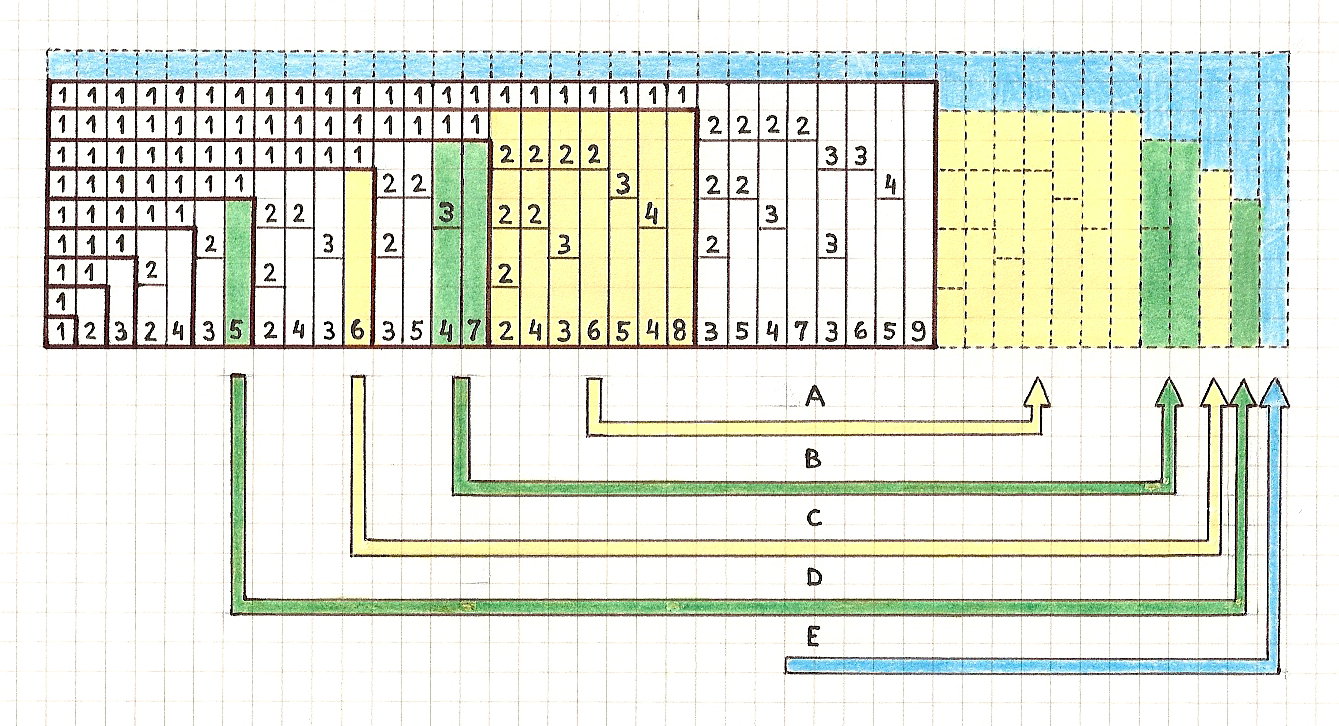
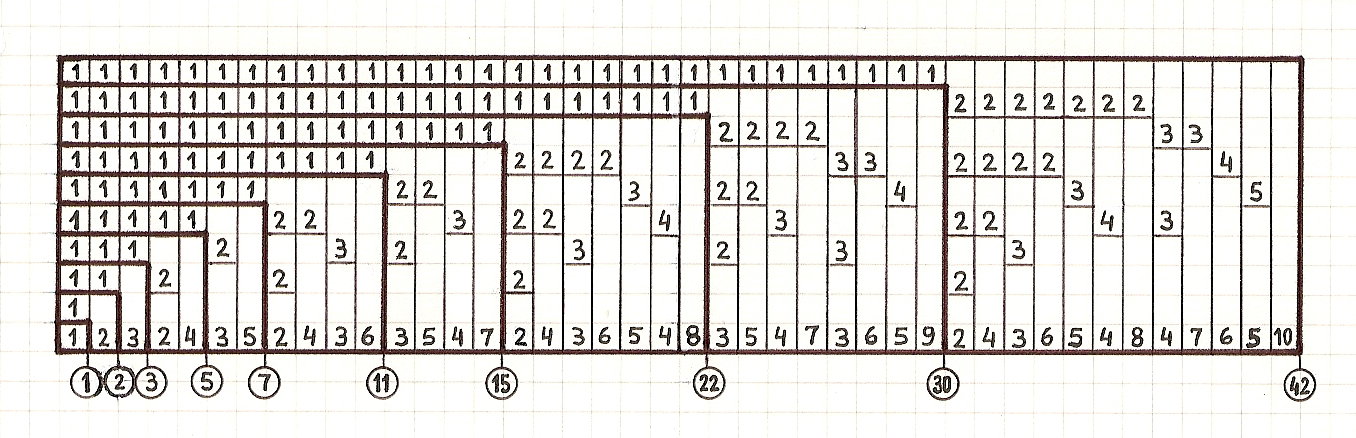
Here we introduce a new type of table which shows the correspondence between divisors and partitions. More precisely the table shows the corresponce between all parts of the last section of the set of partitions of n and all divisors of all terms of the n-th row of A336811, with n >= 1. The mentionded parts and the mentioned divisors are the same numbers (see Example section).
For an equivalent table showing the same kind of correspondence for all partitions of all positive integers see the supersequence A338156.

Examples

			Triangle begins:
  [1];
  [1, 2];
  [1, 3],       [1];
  [1, 2, 4],    [1, 2],    [1];
  [1, 5],       [1, 3],    [1, 2], [1],    [1];
  [1, 2, 3, 6], [1, 2, 4], [1, 3], [1, 2], [1, 2], [1], [1];
  ...
For n = 6 the 6th row of A336811 is [6, 4, 3, 2, 2, 1, 1] so replacing every term with its divisors we have {[1, 2, 3, 6], [1, 2, 4], [1, 3], [1, 2], [1, 2], [1], [1]} the same as the 6th row of this triangle.
Also, if the sequence is written as an irregular tetrahedron so the first six slices are:
  -------------
  [1],
  -------------
  [1, 2];
  -------------
  [1, 3],
  [1];
  -------------
  [1, 2, 4],
  [1, 2],
  [1];
  -------------
  [1, 5],
  [1, 3],
  [1, 2],
  [1],
  [1];
  -------------
  [1, 2, 3, 6],
  [1, 2, 4],
  [1, 3],
  [1, 2],
  [1, 2],
  [1],
  [1];
  -------------
The above slices appear in the lower zone of the following table which shows the correspondence between the mentioned divisors and the parts of the last section of the set of partitions of the positive integers.
The table is infinite. It is formed by three zones as follows:
The upper zone shows the last section of the set of partitions of every positive integer.
The lower zone shows the same numbers but arranged as divisors in accordance with the slices of the tetrahedron mentioned above.
Finally the middle zone shows the connection between the upper zone and the lower zone.
For every positive integer the numbers in the upper zone are the same numbers as in the lower zone.
|---|---------|-----|-------|---------|-----------|-------------|---------------|
| n |         |  1  |   2   |    3    |     4     |      5      |       6       |
|---|---------|-----|-------|---------|-----------|-------------|---------------|
|   |         |     |       |         |           |             |  6            |
| P |         |     |       |         |           |             |  3 3          |
| A |         |     |       |         |           |             |  4 2          |
| R |         |     |       |         |           |             |  2 2 2        |
| T |         |     |       |         |           |  5          |    1          |
| I |         |     |       |         |           |  3 2        |      1        |
| T |         |     |       |         |  4        |    1        |      1        |
| I |         |     |       |         |  2 2      |      1      |        1      |
| O |         |     |       |  3      |    1      |      1      |        1      |
| N |         |     |  2    |    1    |      1    |        1    |          1    |
| S |         |  1  |    1  |      1  |        1  |          1  |            1  |
|---|---------|-----|-------|---------|-----------|-------------|---------------|
.
|---|---------|-----|-------|---------|-----------|-------------|---------------|
|   | A207031 |  1  |  2 1  |  3 1 1  |  6 3 1 1  |  8 3 2 1 1  | 15 8 4 2 1 1  |
| L |         |  |  |  |/|  |  |/|/|  |  |/|/|/|  |  |/|/|/|/|  |  |/|/|/|/|/|  |
| I | A182703 |  1  |  1 1  |  2 0 1  |  3 2 0 1  |  5 1 1 0 1  |  7 4 2 1 0 1  |
| N |         |  *  |  * *  |  * * *  |  * * * *  |  * * * * *  |  * * * * * *  |
| K | A002260 |  1  |  1 2  |  1 2 3  |  1 2 3 4  |  1 2 3 4 5  |  1 2 3 4 5 6  |
|   |         |  =  |  = =  |  = = =  |  = = = =  |  = = = = =  |  = = = = = =  |
|   | A207383 |  1  |  1 2  |  2 0 3  |  3 4 0 4  |  5 2 3 0 5  |  7 8 6 4 0 6  |
|---|---------|-----|-------|---------|-----------|-------------|---------------|
.
|---|---------|-----|-------|---------|-----------|-------------|---------------|
|   | A027750 |  1  |  1 2  |  1   3  |  1 2   4  |  1       5  |  1 2 3     6  |
| D |---------|-----|-------|---------|-----------|-------------|---------------|
| I | A027750 |     |       |  1      |  1 2      |  1   3      |  1 2   4      |
| V |---------|-----|-------|---------|-----------|-------------|---------------|
| I | A027750 |     |       |         |  1        |  1 2        |  1   3        |
| S |---------|-----|-------|---------|-----------|-------------|---------------|
| O | A027750 |     |       |         |           |  1          |  1 2          |
| R | A027750 |     |       |         |           |  1          |  1 2          |
| S |---------|-----|-------|---------|-----------|-------------|---------------|
|   | A027750 |     |       |         |           |             |  1            |
|   | A027750 |     |       |         |           |             |  1            |
|---|---------|-----|-------|---------|-----------|-------------|---------------|
.
Note that every row in the lower zone lists A027750.
The "section" is the simpler substructure of the set of partitions of n that has this property in the three zones.
Also the lower zone for every positive integer can be constructed using the first n terms of A002865. For example: for n = 6 we consider the first 6 terms of A002865 (that is [1, 0, 1, 1, 2, 2]) and then the 6th slice is formed by a block with the divisors of 6, no block with the divisors of 5, one block with the divisors of 4, one block with the divisors of 3, two blocks with the divisors of 2 and two blocks with the divisors of 1.
Note that the lower zone is also in accordance with the tower (a polycube) described in A221529 in which its terraces are the symmetric representation of sigma starting from the top (cf. A237593) and the heights of the mentioned terraces are the partition numbers A000041 starting from the base.
The tower has the same volume (also the same number of cubes) equal to A066186(n) as a prism of partitions of size 1*n*A000041(n).
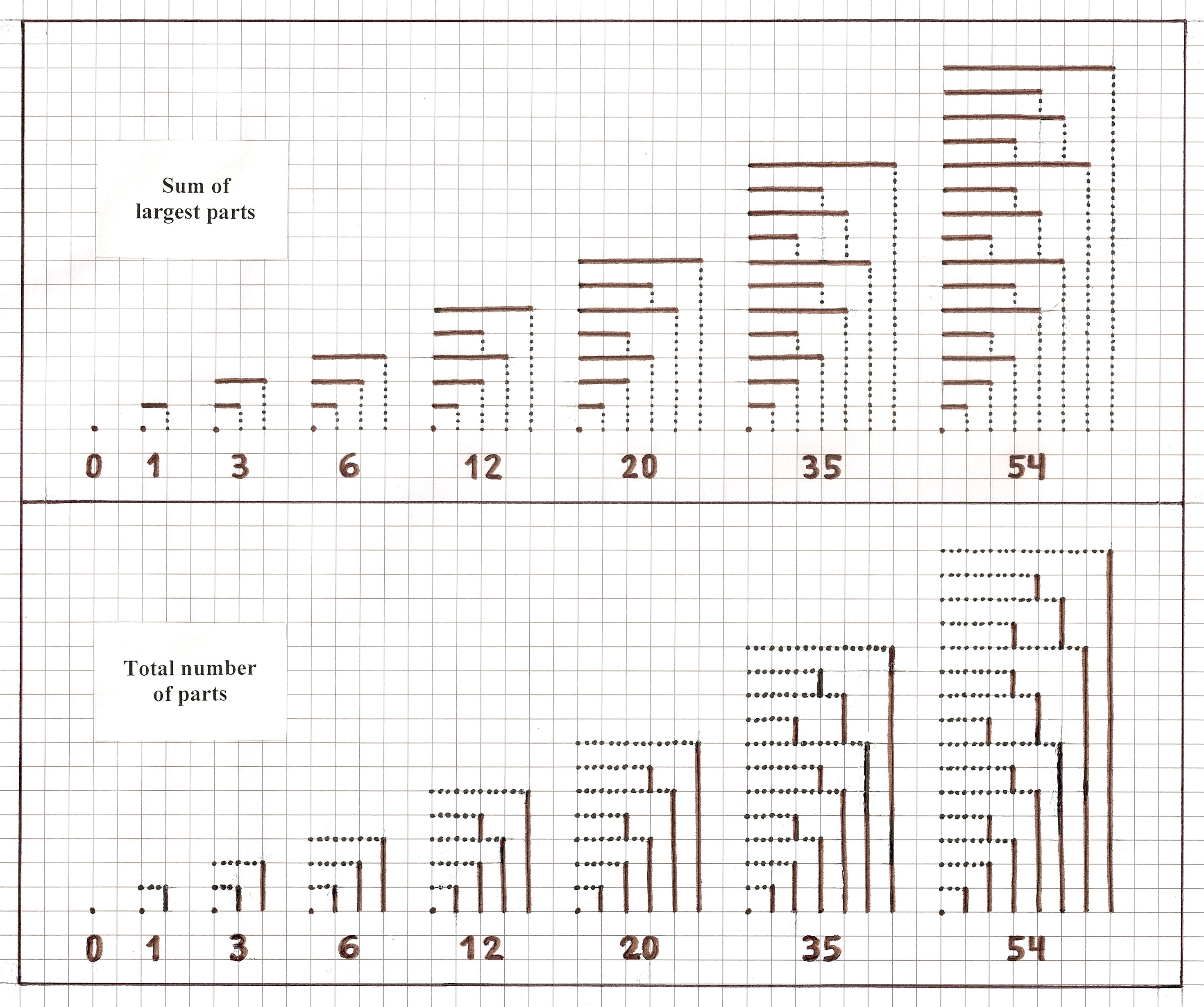
The above table shows the growth step by step of both the prism of partitions and its associated tower since the number of parts in the last section of the set of partitions of n is equal to A138137(n) equaling the number of divisors in the n-th slice of the lower table and equaling the same the number of terms in the n-th row of triangle. Also the sum of all parts in the last section of the set of partitions of n is equal to A138879(n) equaling the sum of all divisors in the n-th slice of the lower table and equaling the sum of the n-th row of triangle.
		

Crossrefs

Programs

  • Mathematica
    A336812[row_]:=Flatten[Table[ConstantArray[Divisors[row-m],PartitionsP[m]-PartitionsP[m-1]],{m,0,row-1}]];
    Array[A336812,10] (* Generates 10 rows *) (* Paolo Xausa, Feb 16 2023 *)
A340035 Irregular triangle read by rows T(n,k) in which row n lists n blocks, where the m-th block consists of A000041(n-m) copies of the divisors of m, with 1 <= m <= n.

Original entry on oeis.org

1, 1, 1, 2, 1, 1, 1, 2, 1, 3, 1, 1, 1, 1, 2, 1, 2, 1, 3, 1, 2, 4, 1, 1, 1, 1, 1, 1, 2, 1, 2, 1, 2, 1, 3, 1, 3, 1, 2, 4, 1, 5, 1, 1, 1, 1, 1, 1, 1, 1, 2, 1, 2, 1, 2, 1, 2, 1, 2, 1, 3, 1, 3, 1, 3, 1, 2, 4, 1, 2, 4, 1, 5, 1, 2, 3, 6, 1, 1, 1, 1, 1, 1, 1, 1, 1, 1, 1, 1, 2, 1, 2, 1, 2, 1, 2
Offset: 1

Views

Author

Omar E. Pol, Dec 26 2020

Keywords

Comments

For further information about the correspondence divisor/part see A338156.

Examples

			Triangle begins:
  1;
  1, 1, 2;
  1, 1, 1, 2, 1, 3;
  1, 1, 1, 1, 2, 1, 2, 1, 3, 1, 2, 4;
  1, 1, 1, 1, 1, 1, 2, 1, 2, 1, 2, 1, 3, 1, 3, 1, 2, 4, 1, 5;
  ...
Written as an irregular tetrahedron the first five slices are:
  1;
  --
  1,
  1, 2;
  -----
  1,
  1,
  1, 2
  1, 3;
  -----
  1,
  1,
  1,
  1, 2,
  1, 2,
  1, 3,
  1, 2, 4;
  --------
  1,
  1,
  1,
  1,
  1,
  1, 2,
  1, 2,
  1, 2,
  1, 3,
  1, 3,
  1, 2, 4,
  1, 5;
--------
The slices of the tetrahedron appear in the upper zone of the following table (formed by three zones) which shows the correspondence between divisors and parts (n = 1..5):
.
|---|---------|-----|-------|---------|-----------|-------------|
| n |         |  1  |   2   |    3    |     4     |      5      |
|---|---------|-----|-------|---------|-----------|-------------|
|   | A027750 |     |       |         |           |  1          |
|   | A027750 |     |       |         |           |  1          |
|   | A027750 |     |       |         |           |  1          |
|   | A027750 |     |       |         |           |  1          |
| D | A027750 |     |       |         |           |  1          |
| I |---------|-----|-------|---------|-----------|-------------|
| V | A027750 |     |       |         |  1        |  1 2        |
| I | A027750 |     |       |         |  1        |  1 2        |
| S | A027750 |     |       |         |  1        |  1 2        |
| O |---------|-----|-------|---------|-----------|-------------|
| R | A027750 |     |       |  1      |  1 2      |  1   3      |
| S | A027750 |     |       |  1      |  1 2      |  1   3      |
|   |---------|-----|-------|---------|-----------|-------------|
|   | A027750 |     |  1    |  1 2    |  1   3    |  1 2   4    |
|   |---------|-----|-------|---------|-----------|-------------|
|   | A027750 |  1  |  1 2  |  1   3  |  1 2   4  |  1       5  |
|---|---------|-----|-------|---------|-----------|-------------|
.
|---|---------|-----|-------|---------|-----------|-------------|
|   | A138785 |  1  |  2 2  |  4 2 3  |  7 6 3 4  | 12 8 6 4 5  |
|   |         |  =  |  = =  |  = = =  |  = = = =  |  = = = = =  |
| L | A002260 |  1  |  1 2  |  1 2 3  |  1 2 3 4  |  1 2 3 4 5  |
| I |         |  *  |  * *  |  * * *  |  * * * *  |  * * * * *  |
| N | A066633 |  1  |  2 1  |  4 1 1  |  7 3 1 1  | 12 4 2 1 1  |
| K |         |  |  |  |\|  |  |\|\|  |  |\|\|\|  |  |\|\|\|\|  |
|   | A181187 |  1  |  3 1  |  6 2 1  | 12 5 2 1  | 20 8 4 2 1  |
|---|---------|-----|-------|---------|-----------|-------------|
.
|---|---------|-----|-------|---------|-----------|-------------|
| P |         |  1  |  1 1  |  1 1 1  |  1 1 1 1  |  1 1 1 1 1  |
| A |         |     |  2    |  2 1    |  2 1 1    |  2 1 1 1    |
| R |         |     |       |  3      |  3 1      |  3 1 1      |
| T |         |     |       |         |  2 2      |  2 2 1      |
| I |         |     |       |         |  4        |  4 1        |
| T |         |     |       |         |           |  3 2        |
| I |         |     |       |         |           |  5          |
| O |         |     |       |         |           |             |
| N |         |     |       |         |           |             |
| S |         |     |       |         |           |             |
|---|---------|-----|-------|---------|-----------|-------------|
.
The table is essentially the same table of A340032 but here, in the upper zone, every row is A027750 instead of A127093.
Also the above table is the table of A338156 upside down.
The connection with the tower described in A221529 is as follows (n = 7):
|--------|------------------------|
| Level  |                        |
| in the | 7th slice of divisors  |
| tower  |                        |
|--------|------------------------|
|  11    |   1,                   |
|  10    |   1,                   |
|   9    |   1,                   |
|   8    |   1,                   |
|   7    |   1,                   |
|   6    |   1,                   |
|   5    |   1,                   |
|   4    |   1,                   |
|   3    |   1,                   |
|   2    |   1,                   |
|   1    |   1,                   |
|--------|------------------------|
|   7    |   1, 2,                |
|   6    |   1, 2,                |
|   5    |   1, 2,                |
|   4    |   1, 2,                |
|   3    |   1, 2,                |
|   2    |   1, 2,                |
|   1    |   1, 2,                |
|--------|------------------------|
|   5    |   1,    3,             |
|   4    |   1,    3,             |
|   3    |   1,    3,             |
|   2    |   1,    3,             |      Level
|   1    |   1,    3,             |             _
|--------|------------------------|       11   | |
|   3    |   1, 2,    4,          |       10   | |
|   2    |   1, 2,    4,          |        9   | |
|   1    |   1, 2,    4,          |        8   |_|_
|--------|------------------------|        7   |   |
|   2    |   1,          5,       |        6   |_ _|_
|   1    |   1,          5,       |        5   |   | |
|--------|------------------------|        4   |_ _|_|_
|   1    |   1, 2, 3,       6,    |        3   |_ _ _| |_
|--------|------------------------|        2   |_ _ _|_ _|_ _
|   1    |   1,                7; |        1   |_ _ _ _|_|_ _|
|--------|------------------------|
             Figure 1.                            Figure 2.
                                                Lateral view
                                                of the tower.
.
                                                _ _ _ _ _ _ _
                                               |_| | | | |   |
                                               |_ _|_| | |   |
                                               |_ _|  _|_|   |
                                               |_ _ _|    _ _|
                                               |_ _ _|  _|
                                               |       |
                                               |_ _ _ _|
.
                                                  Figure 3.
                                                  Top view
                                                of the tower.
.
Figure 1 shows the terms of the 7th row of the triangle arranged as the 7th slice of the tetrahedron. The left hand column (see figure 1) gives the level of the sum of the divisors in the tower (see figures 2 and 3).
		

Crossrefs

Programs

  • Mathematica
    A340035row[n_]:=Flatten[Array[ConstantArray[Divisors[#],PartitionsP[n-#]]&,n]];
    nrows=7;Array[A340035row,nrows] (* Paolo Xausa, Jun 20 2022 *)

A130689 Number of partitions of n such that every part divides the largest part; a(0) = 1.

Original entry on oeis.org

1, 1, 2, 3, 5, 6, 10, 11, 16, 19, 26, 28, 41, 43, 56, 65, 82, 88, 115, 122, 155, 174, 209, 225, 283, 305, 363, 402, 477, 514, 622, 666, 783, 858, 990, 1078, 1268, 1362, 1561, 1708, 1958, 2111, 2433, 2613, 2976, 3247, 3652, 3938, 4482, 4821, 5422
Offset: 0

Views

Author

Vladeta Jovovic, Jul 01 2007

Keywords

Comments

First differs from A130714 at a(11) = 28, A130714(11) = 27. - Gus Wiseman, Apr 23 2021

Examples

			For n = 6 we have 10 such partitions: [1, 1, 1, 1, 1, 1], [1, 1, 1, 1, 2], [1, 1, 2, 2], [2, 2, 2], [1, 1, 1, 3], [3, 3], [1, 1, 4], [2, 4], [1, 5], [6].
From _Gus Wiseman_, Apr 18 2021: (Start)
The a(1) = 1 through a(8) = 16 partitions:
  (1)  (2)   (3)    (4)     (5)      (6)       (7)        (8)
       (11)  (21)   (22)    (41)     (33)      (61)       (44)
             (111)  (31)    (221)    (42)      (331)      (62)
                    (211)   (311)    (51)      (421)      (71)
                    (1111)  (2111)   (222)     (511)      (422)
                            (11111)  (411)     (2221)     (611)
                                     (2211)    (4111)     (2222)
                                     (3111)    (22111)    (3311)
                                     (21111)   (31111)    (4211)
                                     (111111)  (211111)   (5111)
                                               (1111111)  (22211)
                                                          (41111)
                                                          (221111)
                                                          (311111)
                                                          (2111111)
                                                          (11111111)
(End)
		

Crossrefs

The dual version is A083710.
The case without 1's is A339619.
The Heinz numbers of these partitions are the complement of A343337.
The complement is counted by A343341.
The strict case is A343347.
The complement in the strict case is counted by A343377.
A000009 counts strict partitions.
A000041 counts partitions.
A000070 counts partitions with a selected part.
A006128 counts partitions with a selected position.
A015723 counts strict partitions with a selected part.
A072233 counts partitions by sum and greatest part.

Programs

  • Mathematica
    Table[If[n==0,1,Length[Select[IntegerPartitions[n],FreeQ[#,1]&&And@@IntegerQ/@(Max@@#/#)&]]],{n,0,30}] (* Gus Wiseman, Apr 18 2021 *)
  • PARI
    seq(n)={Vec(1 + sum(m=1, n, my(u=divisors(m)); x^m/prod(i=1, #u, 1 - x^u[i] + O(x^(n-m+1)))))} \\ Andrew Howroyd, Apr 17 2021

Formula

G.f.: 1 + Sum_{n>0} x^n/Product_{d divides n} (1-x^d).

A339564 Number of ways to choose a distinct factor in a factorization of n (pointed factorizations).

Original entry on oeis.org

0, 1, 1, 2, 1, 3, 1, 4, 2, 3, 1, 7, 1, 3, 3, 7, 1, 7, 1, 7, 3, 3, 1, 14, 2, 3, 4, 7, 1, 10, 1, 12, 3, 3, 3, 17, 1, 3, 3, 14, 1, 10, 1, 7, 7, 3, 1, 26, 2, 7, 3, 7, 1, 14, 3, 14, 3, 3, 1, 25, 1, 3, 7, 19, 3, 10, 1, 7, 3, 10, 1, 36, 1, 3, 7, 7, 3, 10, 1, 26, 7, 3
Offset: 1

Views

Author

Gus Wiseman, Apr 10 2021

Keywords

Examples

			The pointed factorizations of n for n = 2, 4, 6, 8, 12, 24, 30:
  ((2))  ((4))    ((6))    ((8))      ((12))     ((24))       ((30))
         ((2)*2)  ((2)*3)  ((2)*4)    ((2)*6)    ((3)*8)      ((5)*6)
                  (2*(3))  (2*(4))    (2*(6))    (3*(8))      (5*(6))
                           ((2)*2*2)  ((3)*4)    ((4)*6)      ((2)*15)
                                      (3*(4))    (4*(6))      (2*(15))
                                      ((2)*2*3)  ((2)*12)     ((3)*10)
                                      (2*2*(3))  (2*(12))     (3*(10))
                                                 ((2)*2*6)    ((2)*3*5)
                                                 (2*2*(6))    (2*(3)*5)
                                                 ((2)*3*4)    (2*3*(5))
                                                 (2*(3)*4)
                                                 (2*3*(4))
                                                 ((2)*2*2*3)
                                                 (2*2*2*(3))
		

Crossrefs

The additive version is A000070 (strict: A015723).
The unpointed version is A001055 (strict: A045778, ordered: A074206, listed: A162247).
Allowing point (1) gives A057567.
Choosing a position instead of value gives A066637.
The ordered additive version is A336875.
A000005 counts divisors.
A001787 count normal multisets with a selected position.
A001792 counts compositions with a selected position.
A006128 counts partitions with a selected position.
A066186 count strongly normal multisets with a selected position.
A254577 counts ordered factorizations with a selected position.

Programs

  • Mathematica
    facs[n_]:=If[n<=1,{{}},Join@@Table[Map[Prepend[#,d]&,Select[facs[n/d],Min@@#>=d&]],{d,Rest[Divisors[n]]}]];
    Table[Sum[Length[Union[fac]],{fac,facs[n]}],{n,50}]

Formula

a(n) = A057567(n) - A001055(n).
a(n) = Sum_{d|n, d>1} A001055(n/d).

A338470 Number of integer partitions of n with no part dividing all the others.

Original entry on oeis.org

1, 0, 0, 0, 0, 1, 0, 3, 2, 5, 5, 13, 7, 23, 21, 33, 35, 65, 55, 104, 97, 151, 166, 252, 235, 377, 399, 549, 591, 846, 858, 1237, 1311, 1749, 1934, 2556, 2705, 3659, 3991, 5090, 5608, 7244, 7841, 10086, 11075, 13794, 15420, 19195, 21003, 26240, 29089, 35483
Offset: 0

Views

Author

Gus Wiseman, Mar 23 2021

Keywords

Comments

Alternative name: Number of integer partitions of n that are empty or have smallest part not dividing all the others.

Examples

			The a(5) = 1 through a(12) = 7 partitions (empty column indicated by dot):
  (32)  .  (43)   (53)   (54)    (64)    (65)     (75)
           (52)   (332)  (72)    (73)    (74)     (543)
           (322)         (432)   (433)   (83)     (552)
                         (522)   (532)   (92)     (732)
                         (3222)  (3322)  (443)    (4332)
                                         (533)    (5322)
                                         (542)    (33222)
                                         (632)
                                         (722)
                                         (3332)
                                         (4322)
                                         (5222)
                                         (32222)
		

Crossrefs

The complement is A083710 (strict: A097986).
The strict case is A341450.
The Heinz numbers of these partitions are A342193.
The dual version is A343341.
The case with maximum part not divisible by all the others is A343342.
The case with maximum part divisible by all the others is A343344.
A000005 counts divisors.
A000041 counts partitions.
A000070 counts partitions with a selected part.
A001787 count normal multisets with a selected position.
A006128 counts partitions with a selected position.
A015723 counts strict partitions with a selected part.
A167865 counts strict chains of divisors > 1 summing to n.
A276024 counts positive subset sums.
Sequences with similar formulas: A024994, A047966, A047968, A168111.

Programs

  • Mathematica
    Table[Length[Select[IntegerPartitions[n],#=={}||!And@@IntegerQ/@(#/Min@@#)&]],{n,0,30}]
    (* Second program: *)
    a[n_] := If[n == 0, 1, PartitionsP[n] - Sum[PartitionsP[d-1], {d, Divisors[n]}]];
    a /@ Range[0, 50] (* Jean-François Alcover, May 09 2021, after Andrew Howroyd *)
  • PARI
    a(n)={numbpart(n) - if(n, sumdiv(n, d, numbpart(d-1)))} \\ Andrew Howroyd, Mar 25 2021

Formula

a(n) = A000041(n) - Sum_{d|n} A000041(d-1) for n > 0. - Andrew Howroyd, Mar 25 2021

A138785 Triangle read by rows: T(n,k) is the number of hook lengths equal to k among all hook lengths of all partitions of n (1 <= k <= n).

Original entry on oeis.org

1, 2, 2, 4, 2, 3, 7, 6, 3, 4, 12, 8, 6, 4, 5, 19, 16, 12, 8, 5, 6, 30, 22, 18, 12, 10, 6, 7, 45, 38, 27, 24, 15, 12, 7, 8, 67, 52, 45, 32, 25, 18, 14, 8, 9, 97, 82, 63, 52, 40, 30, 21, 16, 9, 10, 139, 112, 93, 72, 60, 42, 35, 24, 18, 10, 11, 195, 166, 135, 112, 85, 72, 49, 40, 27, 20, 11, 12
Offset: 1

Views

Author

Emeric Deutsch, May 16 2008

Keywords

Comments

T(n,k) is also the sum of all parts of size k in all partitions of n. - Omar E. Pol, Feb 24 2012
T(n,k) is also the sum of all k's that are divisors of all positive integers in a sequence with n blocks where the m-th block consists of A000041(n-m) copies of m, with 1 <= m <= n. - Omar E. Pol, Feb 05 2021

Examples

			T(4,2) = 6 because for the partitions (4), (3,1), (2,2), (2,1,1), (1,1,1,1) of n=4 the hook length multi-sets are {4,3,2,1}, {4,2,1,1}, {3,2,2,1}, {4,1,2,1}, {4,3,2,1}, respectively, containing altogether six 2's.
Triangle starts:
   1;
   2,  2;
   4,  2,  3;
   7,  6,  3,  4;
  12,  8,  6,  4,  5;
  19, 16, 12,  8,  5,  6;
  30, 22, 18, 12, 10,  6,  7;
  45, 38, 27, 24, 15, 12,  7,  8;
  67, 52, 45, 32, 25, 18, 14,  8, 9;
  97, 82, 63, 52, 40, 30, 21, 16, 9, 10;
		

Crossrefs

Row sums yield A066186.

Programs

  • Maple
    g:=sum(k*x^k*t^k/((1-x^k)*(product(1-x^m,m=1..50))),k=1..50): gser:= simplify(series(g,x=0,15)): for n to 12 do P[n]:= sort(coeff(gser,x,n)) end do: for n to 12 do seq(coeff(P[n],t,j),j=1..n) end do; # yields sequence in triangular form
    # second program:
    b:= proc(n, i) option remember; `if`(n=0, [1],
         `if`(i=1, [1, n], (p-> (g-> p(p(b(n, i-1), g),
          [0$i, g[1]]))(`if`(i>n, [0], b(n-i, i))))(
          (f, g)-> zip((x, y)-> x+y, f, g, 0))))
        end:
    T:= n-> (l-> seq(l[i+1]*i, i=1..n))(b(n$2)):
    seq(T(n), n=1..14);  # Alois P. Heinz, Mar 22 2012
  • Mathematica
    max = 12; s = Series[Sum[k*t^k*x^k/((1 - x^k)*Product[1 - x^m, {m, 1, max}]), {k, 1, max}] , {x, 0, max}, {t, 0, max}] // Normal; t[n_, k_] := SeriesCoefficient[s, {x, 0, n}, {t, 0, k}]; Table[t[n, k], {n, 1, max}, {k, 1, n}] // Flatten (* Jean-François Alcover, Jan 17 2014 *)
    Table[Count[Flatten@IntegerPartitions@n, k]*k, {n, 12}, {k, n}] // Flatten (* Robert Price, Jun 15 2020 *)

Formula

T(n,1) = A000070(n-1).
Sum_{k=1..n} k*T(n,k) = A066183(n).
G.f.: Sum(k*t^k*x^k/[(1-x^k)*Product(1-x^m, m=1..infinity)], k=1..infinity).
T(n,k) = k*A066633(n,k).
T(n,k) = Sum_{j=1..n} A207383(j,k). - Omar E. Pol, May 02 2012

A139582 Twice partition numbers.

Original entry on oeis.org

2, 2, 4, 6, 10, 14, 22, 30, 44, 60, 84, 112, 154, 202, 270, 352, 462, 594, 770, 980, 1254, 1584, 2004, 2510, 3150, 3916, 4872, 6020, 7436, 9130, 11208, 13684, 16698, 20286, 24620, 29766, 35954, 43274, 52030, 62370, 74676, 89166, 106348, 126522, 150350, 178268, 211116, 249508, 294546, 347050, 408452
Offset: 0

Views

Author

Omar E. Pol, May 14 2008

Keywords

Comments

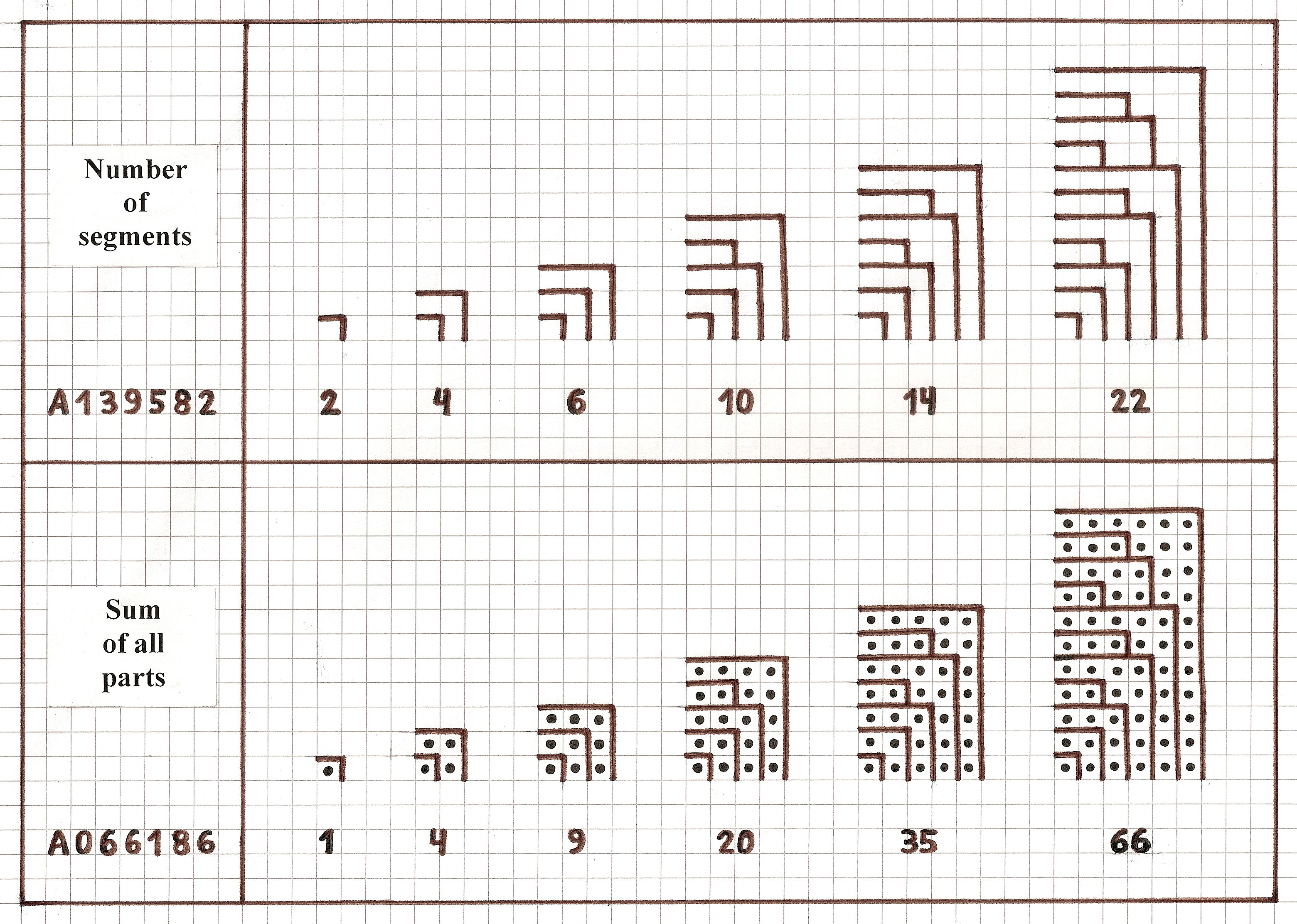
Except for the first term the number of segments needed to draw (on the infinite square grid) a minimalist diagram of regions and partitions of n. Therefore A000041(n) is also the number of pairs of orthogonal segments (L-shaped) in the same diagram (See links section). For the definition of "regions of n" see A206437. - Omar E. Pol, Oct 29 2012

Examples

			The number of partitions of 6 is 11, then a(6) = 2*11 = 22.
		

Crossrefs

Programs

Formula

a(n) = 2*A000041(n).

Extensions

More terms from Omar E. Pol, Feb 11 2018

A182709 Sum of the emergent parts of the partitions of n.

Original entry on oeis.org

0, 0, 0, 2, 3, 11, 14, 33, 45, 81, 109, 185, 237, 372, 490, 715, 928, 1326, 1693, 2348, 2998, 4032, 5119, 6795, 8530, 11132, 13952, 17927, 22314, 28417, 35126, 44279, 54532, 68062, 83422, 103427, 126063, 155207, 188506, 230547, 278788, 339223, 408482
Offset: 1

Views

Author

Omar E. Pol, Nov 28 2010, Nov 29 2010

Keywords

Comments

Here the "emergent parts" of the partitions of n are defined to be the parts (with multiplicity) of all the partitions that do not contain "1" as a part, removed by one copy of the smallest part of every partition. Note that these parts are located in the head of the last section of the set of partitions of n. For more information see A182699.
Also total sum of parts of the regions that do not contain 1 as a part in the last section of the set of partitions of n (Cf. A083751, A187219). - Omar E. Pol, Mar 04 2012

Examples

			For n=7 the partitions of 7 that do not contain "1" as a part are
7
4 + 3
5 + 2
3 + 2 + 2
Then remove one copy of the smallest part of every partition. The rest are the emergent parts:
.,
4, .
5, .
3, 2, .
The sum of these parts is 4 + 5 + 3 + 2 = 14, so a(7)=14.
For n=10 the illustration in the link shows the location of the emergent parts (colored yellow and green) and the location of the filler parts (colored blue) in the last section of the set of partitions of 10.
		

Crossrefs

Programs

  • Maple
    b:= proc(n, i) option remember;
          if n<0 then 0
        elif n=0 then 1
        elif i<2 then 0
        else b(n, i-1) +b(n-i, i)
          fi
        end:
    c:= proc(n, i, k) option remember;
          if n<0 then 0
        elif n=0 then k
        elif i<2 then 0
        else c(n, i-1, k) +c(n-i, i, i)
          fi
        end:
    a:= n-> n*b(n, n) - c(n, n, 0):
    seq(a(n), n=1..40);  #  Alois P. Heinz, Dec 01 2010
  • Mathematica
    f[n_]:=Total[Flatten[Most/@Select[IntegerPartitions[n],!MemberQ[#,1]&]]]; Table[f[i],{i,50}] (* Harvey P. Dale, Dec 28 2010 *)
    b[n_, i_] := b[n, i] = Which[n<0, 0, n==0, 1, i<2, 0, True, b[n, i-1] + b[n - i, i]]; c[n_, i_, k_] := c[n, i, k] = Which[n<0, 0, n==0, k, i<2, 0, True, c[n, i-1, k] + c[n-i, i, i]]; a[n_] := n*b[n, n] - c[n, n, 0]; Table[a[n], {n, 1, 40}] (* Jean-François Alcover, Oct 08 2015, after Alois P. Heinz *)

Formula

a(n) = A138880(n) - A182708(n).
a(n) = A066186(n) - A066186(n-1) - A046746(n) = A138879(n) - A046746(n). - Omar E. Pol, Aug 01 2013
a(n) ~ Pi * exp(Pi*sqrt(2*n/3)) / (12*sqrt(2*n)) * (1 - (3*sqrt(3/2)/Pi + 13*Pi/(24*sqrt(6)))/sqrt(n)). - Vaclav Kotesovec, Jan 03 2019, extended Jul 05 2019

Extensions

More terms from Alois P. Heinz, Dec 01 2010

A183011 (24n - 1)p(n): traces of partition class polynomials, with a(0) = -1.

Original entry on oeis.org

-1, 23, 94, 213, 475, 833, 1573, 2505, 4202, 6450, 10038, 14728, 22099, 31411, 45225, 63184, 88473, 120879, 165935, 222950, 300333, 398376, 528054, 691505, 905625, 1172842, 1517628, 1947470, 2494778, 3172675, 4029276, 5083606, 6403683, 8023113
Offset: 0

Views

Author

Omar E. Pol, Jan 21 2011

Keywords

Comments

a(n) is also Tr(n), the numerator of the finite algebraic formula for the number of partitions of n, if n >= 1. The formula is p(n) = Tr(n)/(24*n - 1), n >= 1. See theorem 1.1 of the Bruinier-Ono paper in the link. For the denominators see A183010.
a(n) is also the coefficient of the second term (the trace) in the n-th Bruinier-Ono "partition polynomial" H_n(x), if n >= 1. See the Bruinier-Ono paper, theorem 1.1 and chapter 5 "Examples". For the coefficients of the 4th terms see A187218. - Omar E. Pol, Jul 10 2011
In the Bruinier-Ono-Sutherland paper (Jan 23 2013) partition polynomials are called "partition class polynomials". See also Sutherland's table of Hpart_n(x) in link section. - Omar E. Pol, Feb 20 2013

Examples

			1. For n = 6, the number of partitions of 6 is 11, so a(6) = (24*6 - 1)*11 = 143*11 = 1573.
2. For n = 1, in the Bruinier-Ono paper, chapter 5, the first "partition polynomial" is H_1(x) = x^3 - 23*x^2 + (3592/23)*x - 419. The coefficient of the second term (the trace) is 23, so a(1) = 23.
G.f. = -1 + 23*x + 94*x^2 + 213*x^3 + 475*x^4 + 833*x^5 + 1573*x^6 + 2505*x^7 + ...
G.f. = -q^-1 + 23*q^23 + 94*q^47 + 213*q^71 + 475*q^95 + 833*q^119 + 1573*q^143 + ...
		

Crossrefs

Positive terms are the partial sums of A183012, also the column 24 of A182729.

Programs

  • Mathematica
    a[ n_] := (24 n - 1) SeriesCoefficient[ 1 / QPochhammer[ x], {x, 0, n}]; (* Michael Somos, Jun 26 2017 *)
  • PARI
    {a(n) = if( n<0, 0, (24*n - 1) * numbpart(n))}; /* Michael Somos, Aug 28 2013 */

Formula

a(n) = A183010(n)*A000041(n).
a(n) = 24*A066186(n) - A000041(n) = A183009(n) - A000041(n) = (A008606(n)-1)*A000041(n).
a(n) = 12M_2(n) - p(n) = 24spt(n) + 12N_2(n) - p(n) = 12*A220909(n) - A000041(n) = 24*A092269(n) + 12*A220908(n) - A000041(n), n >= 1. - Omar E. Pol, Feb 17 2013
G.f.: Sum_{k >= 0} a(k) * q^(24*k - 1) = q * d/dq (1/q * Product_{k > 0} 1 / (1 - q^(24*k))). - Michael Somos, Aug 28 2013

A211978 Total number of parts in all partitions of n plus the sum of largest parts of all partitions of n.

Original entry on oeis.org

0, 2, 6, 12, 24, 40, 70, 108, 172, 256, 384, 550, 798, 1112, 1560, 2136, 2926, 3930, 5288, 6996, 9260, 12104, 15798, 20412, 26348, 33702, 43044, 54588, 69090, 86906, 109126, 136270, 169854, 210732, 260924, 321752, 396028, 485624, 594402, 725174, 883092, 1072208
Offset: 0

Views

Author

Omar E. Pol, Jan 03 2013

Keywords

Comments

Also twice A006128, because the total number of parts in all partitions of n equals the sum of largest parts of all partitions of n. For a proof without words see the illustration of initial terms. Note that the sum of the lengths of all horizontal segments equals the sum of largest parts of all partitions of n. On the other hand, the sum of the lengths of all vertical segments equals the total number of parts of all partition of n. Therefore the sum of lengths of all horizontal segments equals the sum of lengths of all vertical segments.
a(n) is also the sum of the semiperimeters of the Ferrers boards of the partitions of n. Example: a(2)=6; indeed, the Ferrers boards of the partitions [2] and [1,1] of 2 are 2x1 rectangles; the sum of their semiperimeters is 3 + 3 = 6. - Emeric Deutsch, Oct 07 2016
a(n) is also the sum of the semiperimeters of the regions of the set of partitions of n. See the first illustration in the Example section. For more information see A278355. - Omar E. Pol, Nov 23 2016

Examples

			Illustration of initial terms as a minimalist diagram of regions of the set of partitions of n, for n = 1..6:
.                                         _ _ _ _ _ _
.                                         _ _ _      |
.                                         _ _ _|_    |
.                                         _ _    |   |
.                             _ _ _ _ _   _ _|_ _|_  |
.                             _ _ _    |  _ _ _    | |
.                   _ _ _ _   _ _ _|_  |  _ _ _|_  | |
.                   _ _    |  _ _    | |  _ _    | | |
.           _ _ _   _ _|_  |  _ _|_  | |  _ _|_  | | |
.     _ _   _ _  |  _ _  | |  _ _  | | |  _ _  | | | |
. _   _  |  _  | |  _  | | |  _  | | | |  _  | | | | |
.  |   | |   | | |   | | | |   | | | | |   | | | | | |
.
. 2    6     12        24         40          70
.
Also using the elements from the diagram we can draw an infinite Dyck path in which the n-th odd-indexed segment has A141285(n) up-steps and the n-th even-indexed segment has A194446(n) down-steps. Note that the n-th largest peak between two valleys at height 0 is also the partition number A000041(n) as shown below:
.
11...........................................................
.                                                           /\
.                                                          /  \
.                                                         /    \
7..................................                      /      \
.                                 /\                    /        \
5....................            /  \                /\/          \
.                   /\          /    \          /\  /              \
3..........        /  \        /      \        /  \/                \
2.....    /\      /    \    /\/        \      /                      \
1..  /\  /  \  /\/      \  /            \  /\/                        \
0 /\/  \/    \/          \/              \/                            \
. 0,2,  6,   12,         24,             40,                          70...
.
		

Crossrefs

Programs

  • Maple
    Q := sum(x^j/(1-x^j), j = 1 .. i): R := product(1-x^j, j = 1 .. i): g := sum(x^i*(1+i+Q)/R, i = 1 .. 100): gser := series(g, x = 0, 50): seq(coeff(gser, x, n), n = 0 .. 41); # Emeric Deutsch, Oct 07 2016
  • Mathematica
    Array[2 Sum[DivisorSigma[0, m] PartitionsP[# - m], {m, #}] &, 42, 0] (* Michael De Vlieger, Mar 20 2020 *)

Formula

a(n) = 2*A006128(n).
a(n) = A225600(2*A000041(n)) = A225600(A139582(n)), n >= 1.
a(n) = (Sum_{m=1..p(n)} A194446(m)) + (Sum_{m=1..p(n)} A141285(m)) = 2*Sum_{m=1..p(n)} A194446(m) = 2*Sum_{m=1..p(n)} A141285(m), where p(n) = A000041(n), n >= 1.
The trivariate g.f. G(t,s,x) of the partitions of a nonnegative integer relative to weight (marked by x), number of parts (marked by t), and largest part (marked by s) is G(t,s,x) = Sum_{i>=1} t*s^i*x^i/product_{j=1..i} (1-tx^j). Setting s = t, we obtain the bivariate g.f. of the partitions relative to weight (marked by x) and semiperimeter of the Ferrers board (marked by t). The g.f. of a(n) is g(x) = Sum_{i>=1} ((x^i*(1 + i + Q(x))/R(x)), where Q(x) = sum_{j=1..i} (x^j/(1 - x^j)) and R(x) = product_{j=1..i}(1-x^j). g(x) has been obtained by setting t = 1 in dG(t,t,x))/dt. - Emeric Deutsch, Oct 07 2016
Previous Showing 21-30 of 183 results. Next