cp's OEIS Frontend

This is a front-end for the Online Encyclopedia of Integer Sequences, made by Christian Perfect. The idea is to provide OEIS entries in non-ancient HTML, and then to think about how they're presented visually. The source code is on GitHub.

Previous Showing 11-20 of 70 results. Next

A338702 a(n) is the least k such that A060681(k) = n.

Original entry on oeis.org

1, 2, 3, 6, 5, 10, 7, 14, 16, 18, 11, 22, 13, 26, 21, 30, 17, 34, 19, 38, 25, 42, 23, 46, 48, 50, 39, 54, 29, 58, 31, 62, 64, 66, 51, 70, 37, 74, 57, 78, 41, 82, 43, 86, 55, 90, 47, 94, 96, 98, 75, 102, 53, 106, 81, 110, 112, 114, 59, 118, 61, 122, 93, 126
Offset: 0

Views

Author

Rémy Sigrist, Apr 24 2021

Keywords

Examples

			The first terms of A060681 are: 0, 1, 2, 2, 4, 3, 6, 4, 6, 5, 10.
So: a(0) = 1, a(1) = 2, a(2) = 3, a(4) = 5, a(3) = 6, a(6) = 7, a(10) = 11.
		

Crossrefs

Cf. A060681.

Programs

  • PARI
    A060681(n) = if (n==1, 0, my (d=divisors(n)); d[#d]-d[#d-1])
    { u=0; a=vector(64, n, -1); for (k=1, oo, v=A060681(k); if (v<#a && a[1+v]<0, a[1+v]=k; while (a[1+u]>=0, print1 (a[u++]", "); if (u==#a, break (2))))) }

Formula

a(n) <= 2*n for any n > 0.

A339913 a(n) = x/gcd(n,x), where x = 1+A060681(n).

Original entry on oeis.org

1, 1, 1, 3, 1, 2, 1, 5, 7, 3, 1, 7, 1, 4, 11, 9, 1, 5, 1, 11, 5, 6, 1, 13, 21, 7, 19, 15, 1, 8, 1, 17, 23, 9, 29, 19, 1, 10, 9, 21, 1, 11, 1, 23, 31, 12, 1, 25, 43, 13, 35, 27, 1, 14, 9, 29, 13, 15, 1, 31, 1, 16, 43, 33, 53, 17, 1, 35, 47, 18, 1, 37, 1, 19, 17, 39, 67, 20, 1, 41, 55, 21, 1, 43, 69, 22, 59, 45, 1, 23
Offset: 1

Views

Author

Antti Karttunen, Jan 01 2021

Keywords

Crossrefs

Programs

  • PARI
    A060681(n) = (n-if(1==n,n,n/vecmin(factor(n)[,1])));
    A339913(n) = { my(x=1+A060681(n)); (x/gcd(n,x)); };

Formula

a(n) = (1+A060681(n)) / A323071(n).

A359454 Decimal expansion of Knopfmacher's limit: Limit_{x -> 1 from below} (1/(1-x)) * Product_{k>=2} (1 - x^m(k)/(k+1)), where m(k) = A060681(k) = k - k/A020639(k).

Original entry on oeis.org

2, 2, 9, 2, 1, 7, 3, 6, 9, 5, 3
Offset: 1

Views

Author

Amiram Eldar, Jan 02 2023

Keywords

Comments

The problem of calculating this limit was proposed by Knopfmacher (1999) and its value was calculated by Lichtblau (2000).

Examples

			2.2921736953...
		

Crossrefs

A006093 a(n) = prime(n) - 1.

Original entry on oeis.org

1, 2, 4, 6, 10, 12, 16, 18, 22, 28, 30, 36, 40, 42, 46, 52, 58, 60, 66, 70, 72, 78, 82, 88, 96, 100, 102, 106, 108, 112, 126, 130, 136, 138, 148, 150, 156, 162, 166, 172, 178, 180, 190, 192, 196, 198, 210, 222, 226, 228, 232, 238, 240, 250, 256, 262, 268, 270
Offset: 1

Views

Author

Keywords

Comments

These are also the numbers that cannot be written as i*j + i + j (i,j >= 1). - Rainer Rosenthal, Jun 24 2001; Henry Bottomley, Jul 06 2002
The values of k for which Sum_{j=0..n} (-1)^j*binomial(k, j)*binomial(k-1-j, n-j)/(j+1) produces an integer for all n such that n < k. Setting k=10 yields [0, 1, 4, 11, 19, 23, 19, 11, 4, 1, 0] for n = [-1, 0, 1, 2, 3, 4, 5, 6, 7, 8, 9], so 10 is in the sequence. Setting k=3 yields [0, 1, 1/2, 1/2] for n = [-1, 0, 1, 2], so 3 is not in the sequence. - Dug Eichelberger (dug(AT)mit.edu), May 14 2001
n such that x^n + x^(n-1) + x^(n-2) + ... + x + 1 is irreducible. - Robert G. Wilson v, Jun 22 2002
Records for Euler totient function phi.
Together with 0, n such that (n+1) divides (n!+1). - Benoit Cloitre, Aug 20 2002; corrected by Charles R Greathouse IV, Apr 20 2010
n such that phi(n^2) = phi(n^2 + n). - Jon Perry, Feb 19 2004
Numbers having only the trivial perfect partition consisting of a(n) 1's. - Lekraj Beedassy, Jul 23 2006
Numbers n such that the sequence {binomial coefficient C(k,n), k >= n } contains exactly one prime. - Artur Jasinski, Dec 02 2007
Record values of A143201: a(n) = A143201(A001747(n+1)) for n > 1. - Reinhard Zumkeller, Aug 12 2008
From Reinhard Zumkeller, Jul 10 2009: (Start)
The first N terms can be generated by the following sieving process:
start with {1, 2, 3, 4, ..., N - 1, N};
for i := 1 until SQRT(N) do
(if (i is not striked out) then
(for j := 2 * i + 1 step i + 1 until N do
(strike j from the list)));
remaining numbers = {a(n): a(n) <= N}. (End)
a(n) = partial sums of A075526(n-1) = Sum_{1..n} A075526(n-1) = Sum_{1..n} (A008578(n+1) - A008578(n)) = Sum_{1..n} (A158611(n+2) - A158611(n+1)) for n >= 1. - Jaroslav Krizek, Aug 04 2009
A171400(a(n)) = 1 for n <> 2: subsequence of A171401, except for a(2) = 2. - Reinhard Zumkeller, Dec 08 2009
Numerator of (1 - 1/prime(n)). - Juri-Stepan Gerasimov, Jun 05 2010
Numbers n such that A002322(n+1) = n. This statement is stronger than repeating the property of the entries in A002322, because it also says in reciprocity that this sequence here contains no numbers beyond the Carmichael numbers with that property. - Michel Lagneau, Dec 12 2010
a(n) = A192134(A095874(A000040(n))); subsequence of A192133. - Reinhard Zumkeller, Jun 26 2011
prime(a(n)) + prime(k) < prime(a(k) + k) for at least one k <= a(n): A212210(a(n),k) < 0. - Reinhard Zumkeller, May 05 2012
Except for the first term, numbers n such that the sum of first n natural numbers does not divide the product of first n natural numbers; that is, n*(n + 1)/2 does not divide n!. - Jayanta Basu, Apr 24 2013
BigOmega(a(n)) equals BigOmega(a(n)*(a(n) + 1)/2), where BigOmega = A001222. Rationale: BigOmega of the product on the right hand side factorizes as BigOmega(a/2) + Bigomega(a+1) = BigOmega(a/2) + 1 because a/2 and a + 1 are coprime, because BigOmega is additive, and because a + 1 is prime. Furthermore Bigomega(a/2) = Bigomega(a) - 1 because essentially all 'a' are even. - Irina Gerasimova, Jun 06 2013
Record values of A060681. - Omar E. Pol, Oct 26 2013
Deficiency of n-th prime. - Omar E. Pol, Jan 30 2014
Conjecture: All the sums Sum_{k=s..t} 1/a(k) with 1 <= s <= t are pairwise distinct. In general, for any integers d >= -1 and m > 0, if Sum_{k=i..j} 1/(prime(k)+d)^m = Sum_{k=s..t} 1/(prime(k)+d)^m with 0 < i <= j and 0 < s <= t then we must have (i,j) = (s,t), unless d = m = 1 and {(i,j),(s,t)} = {(4,4),(8,10)} or {(4,7),(5,10)}. (Note that 1/(prime(8)+1)+1/(prime(9)+1)+1/(prime(10)+1) = 1/(prime(4)+1) and Sum_{k=5..10} 1/(prime(k)+1) = 1/(prime(4)+1) + Sum_{k=5..7} 1/(prime(k)+1).) - Zhi-Wei Sun, Sep 09 2015
Numbers n such that (prime(i)^n + n) is divisible by (n+1), for all i >= 1, except when prime(i) = n+1. - Richard R. Forberg, Aug 11 2016
a(n) is the period of Fubini numbers (A000670) over the n-th prime. - Federico Provvedi, Nov 28 2020

References

  • Archimedeans Problems Drive, Eureka, 40 (1979), 28.
  • Harvey Dubner, Generalized Fermat primes, J. Recreational Math., 18 (1985): 279-280.
  • M. Gardner, The Colossal Book of Mathematics, pp. 31, W. W. Norton & Co., NY, 2001.
  • M. Gardner, Mathematical Circus, pp. 251-2, Alfred A. Knopf, NY, 1979.
  • N. J. A. Sloane and Simon Plouffe, The Encyclopedia of Integer Sequences, Academic Press, 1995 (includes this sequence).

Crossrefs

a(n) = K(n, 1) and A034693(K(n, 1)) = 1 for all n. The subscript n refers to this sequence and K(n, 1) is the index in A034693. - Labos Elemer
Cf. A000040, A034694. Different from A075728.
Complement of A072668 (composite numbers minus 1), A072670(a(n))=0.
Essentially the same as A039915.
Cf. A101301 (partial sums), A005867 (partial products).
Column 1 of the following arrays/triangles: A087738, A249741, A352707, A378979, A379010.
The last diagonal of A162619, and of A174996, the first diagonal in A131424.
Row lengths of irregular triangles A086145, A124223, A212157.

Programs

Formula

a(n) = (p-1)! mod p where p is the n-th prime, by Wilson's theorem. - Jonathan Sondow, Jul 13 2010
a(n) = A000010(prime(n)) = A000010(A006005(n)). - Antti Karttunen, Dec 16 2012
a(n) = A005867(n+1)/A005867(n). - Eric Desbiaux, May 07 2013
a(n) = A000040(n) - 1. - Omar E. Pol, Oct 26 2013
a(n) = A033879(A000040(n)). - Omar E. Pol, Jan 30 2014

Extensions

Correction for change of offset in A158611 and A008578 in Aug 2009 Jaroslav Krizek, Jan 27 2010
Obfuscating comments removed by Joerg Arndt, Mar 11 2010
Edited by Charles R Greathouse IV, Apr 20 2010

A032742 a(1) = 1; for n > 1, a(n) = largest proper divisor of n (that is, for n>1, maximum divisor d of n in range 1 <= d < n).

Original entry on oeis.org

1, 1, 1, 2, 1, 3, 1, 4, 3, 5, 1, 6, 1, 7, 5, 8, 1, 9, 1, 10, 7, 11, 1, 12, 5, 13, 9, 14, 1, 15, 1, 16, 11, 17, 7, 18, 1, 19, 13, 20, 1, 21, 1, 22, 15, 23, 1, 24, 7, 25, 17, 26, 1, 27, 11, 28, 19, 29, 1, 30, 1, 31, 21, 32, 13, 33, 1, 34, 23, 35, 1, 36, 1, 37, 25, 38, 11, 39, 1, 40
Offset: 1

Views

Author

Patrick De Geest, May 15 1998

Keywords

Comments

It seems that a(n) = Max_{j=n+1..2n-1} gcd(n,j). - Labos Elemer, May 22 2002
This is correct: No integer in the range [n+1, 2n-1] has n as its divisor, but certainly at least one multiple of the largest proper divisor of n will occur there (e.g., if it is n/2, then at n + (n/2)). - Antti Karttunen, Dec 18 2014
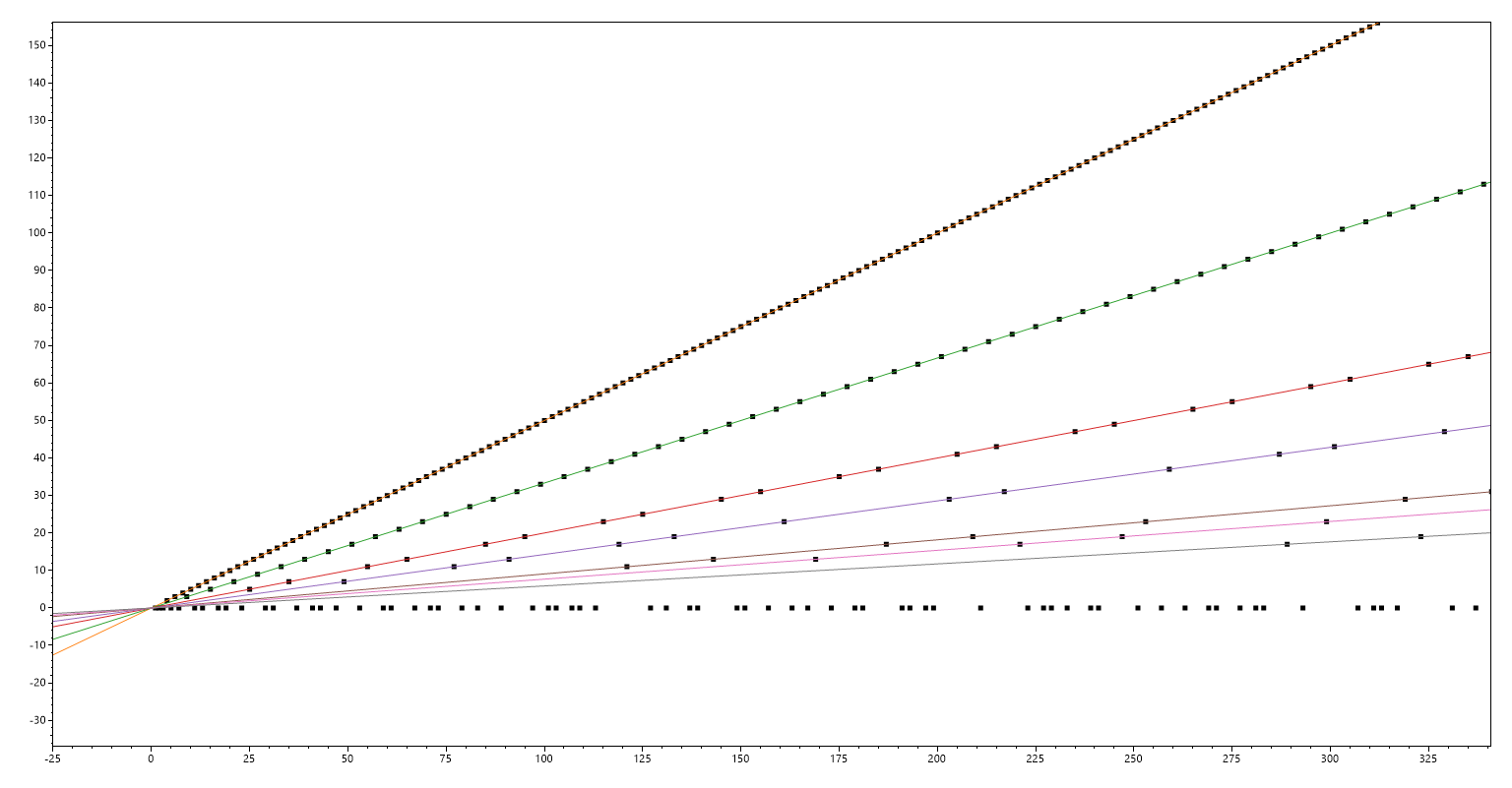
The slopes of the visible lines made by the points in the scatter plot are 1/2, 1/3, 1/5, 1/7, ... (reciprocals of primes). - Moosa Nasir, Jun 19 2022

Crossrefs

Maximal GCD of k positive integers with sum n for k = 2..10: this sequence (k=2,n>=2), A355249 (k=3), A355319 (k=4), A355366 (k=5), A355368 (k=6), A355402 (k=7), A354598 (k=8), A354599 (k=9), A354601 (k=10).

Programs

  • Haskell
    a032742 n = n `div` a020639 n  -- Reinhard Zumkeller, Oct 03 2012
    
  • Maple
    A032742 :=proc(n) option remember; if n = 1 then 1; else numtheory[divisors](n) minus {n} ; max(op(%)) ; end if; end proc: # R. J. Mathar, Jun 13 2011
    1, seq(n/min(numtheory:-factorset(n)), n=2..1000); # Robert Israel, Dec 18 2014
  • Mathematica
    f[n_] := If[n == 1, 1, Divisors[n][[-2]]]; Table[f[n], {n, 100}] (* Vladimir Joseph Stephan Orlovsky, Mar 03 2010 *)
    Join[{1},Divisors[#][[-2]]&/@Range[2,80]] (* Harvey P. Dale, Nov 29 2011 *)
    a[n_] := n/FactorInteger[n][[1, 1]]; Array[a, 100] (* Amiram Eldar, Nov 26 2020 *)
    Table[Which[n==1,1,PrimeQ[n],1,True,Divisors[n][[-2]]],{n,80}] (* Harvey P. Dale, Feb 02 2022 *)
  • PARI
    a(n)=if(n==1,1,n/factor(n)[1,1]) \\ Charles R Greathouse IV, Jun 15 2011
    
  • Python
    from sympy import factorint
    def a(n): return 1 if n == 1 else n//min(factorint(n))
    print([a(n) for n in range(1, 81)]) # Michael S. Branicky, Jun 21 2022
  • Scheme
    (define (A032742 n) (/ n (A020639 n))) ;; Antti Karttunen, Dec 18 2014
    

Formula

a(n) = n / A020639(n).
Other identities and observations:
A054576(n) = a(a(n)); A117358(n) = a(a(a(n))) = a(A054576(n)); a(A008578(n)) = 1, a(A002808(n)) > 1. - Reinhard Zumkeller, Mar 10 2006
a(n) = A130064(n) / A006530(n). - Reinhard Zumkeller, May 05 2007
a(m)*a(n) < a(m*n) for m and n > 1. - Reinhard Zumkeller, Apr 11 2008
a(m*n) = max(m*a(n), n*a(m)). - Robert Israel, Dec 18 2014
From Antti Karttunen, Mar 31 2018: (Start)
a(n) = n - A060681(n).
For n > 1, a(n) = A003961^(r)(A246277(n)), where r = A055396(n)-1 and A003961^(r)(n) stands for shifting the prime factorization of n by r positions towards larger primes.
For all n >= 1, A276085(a(A276086(n))) = A276151(n).
(End)
Sum_{k=1..n} a(k) ~ c * n^2, where c = (1/2) * Sum_{k>=1} A005867(k-1)/(prime(k)*A002110(k)) = 0.165049... . - Amiram Eldar, Nov 19 2022

Extensions

Definition clarified by N. J. A. Sloane, Dec 26 2022

A064097 A quasi-logarithm defined inductively by a(1) = 0 and a(p) = 1 + a(p-1) if p is prime and a(n*m) = a(n) + a(m) if m,n > 1.

Original entry on oeis.org

0, 1, 2, 2, 3, 3, 4, 3, 4, 4, 5, 4, 5, 5, 5, 4, 5, 5, 6, 5, 6, 6, 7, 5, 6, 6, 6, 6, 7, 6, 7, 5, 7, 6, 7, 6, 7, 7, 7, 6, 7, 7, 8, 7, 7, 8, 9, 6, 8, 7, 7, 7, 8, 7, 8, 7, 8, 8, 9, 7, 8, 8, 8, 6, 8, 8, 9, 7, 9, 8, 9, 7, 8, 8, 8, 8, 9, 8, 9, 7, 8, 8, 9, 8, 8, 9, 9, 8, 9, 8, 9, 9, 9, 10, 9, 7, 8, 9, 9, 8, 9, 8, 9, 8
Offset: 1

Views

Author

Thomas Schulze (jazariel(AT)tiscalenet.it), Sep 16 2001

Keywords

Comments

Note that this is the logarithm of a completely multiplicative function. - Michael Somos
Number of iterations of r -> r - (largest divisor d < r) needed to reach 1 starting at r = n. a(n) = a(n - A032742(n)) + 1 for n >= 2. - Jaroslav Krizek, Jan 28 2010
From Antti Karttunen, Apr 04 2020: (Start)
Krizek's comment above stems from the fact that n - n/p = (p-1)*(n/p), where p is the least prime dividing n [= A020639(n), thus n/p = A032742(n)] and because this is fully additive sequence we can write a(n) = a(p) + a(n/p) = (1+a(p-1)) + a(n/p) = 1 + a((p-1)*(n/p)) = 1 + a(n - n/p), for any composite n.
Note that in above formula p can be any prime factor of n, not only the smallest, which proves Robert G. Wilson v's comment in A333123 that all such iteration paths from n to 1 are of the same length, regardless of the route taken.
(End)
From Antti Karttunen, May 11 2020: (Start)
Moreover, those paths form the chains of a graded poset, which is also a lattice. See the Mathematics Stack Exchange link.
Keeping the formula otherwise same, but changing it for primes either as a(p) = 1 + a(A064989(p)), a(p) = 1 + a(floor(p/2)) or a(p) = 1 + a(A048673(p)) gives sequences A056239, A064415 and A334200 respectively.
(End)
a(n) is the number of iterations r->A060681(r) to reach 1 starting at r=n. - R. J. Mathar, Nov 06 2023

Examples

			a(19) = 6: 19 - 1 = 18; 18 - 9 = 9; 9 - 3 = 6; 6 - 3 = 3; 3 - 1 = 2; 2 - 1 = 1. That is a total of 6 iterations. - _Jaroslav Krizek_, Jan 28 2010
From _Antti Karttunen_, Apr 04 2020: (Start)
We can follow also alternative routes, where we do not always select the largest proper divisor to subtract, for example, from 19 to 1, we could go as:
19-1 = 18; 18-(18/3) = 12; 12-(12/2) = 6; 6-(6/3) = 4; 4-(4/2) = 2; 2-(2/2) = 1, or as
19-1 = 18; 18-(18/3) = 12; 12-(12/3) = 8; 8-(8/2) = 4; 4-(4/2) = 2; 2-(2/2) = 1,
both of which also have exactly 6 iterations.
(End)
		

Crossrefs

Similar to A061373 which uses the same recurrence relation but a(1) = 1.
Cf. A000079 (position of last occurrence), A105017 (position of records), A334197 (positions of record jumps upward).
Partial sums of A334090.
Cf. also A056239.

Programs

  • Haskell
    import Data.List (genericIndex)
    a064097 n = genericIndex a064097_list (n-1)
    a064097_list = 0 : f 2 where
       f x | x == spf  = 1 + a064097 (spf - 1) : f (x + 1)
           | otherwise = a064097 spf + a064097 (x `div` spf) : f (x + 1)
           where spf = a020639 x
    -- Reinhard Zumkeller, Mar 08 2013
    
  • Maple
    a:= proc(n) option remember;
          add((1+a(i[1]-1))*i[2], i=ifactors(n)[2])
        end:
    seq(a(n), n=1..120);  # Alois P. Heinz, Apr 26 2019
    # alternative which can be even used outside this entry
    A064097 := proc(n)
            option remember ;
            add((1+procname(i[1]-1))*i[2], i=ifactors(n)[2]) ;
    end proc:
    seq(A064097(n),n=1..100) ; # R. J. Mathar, Aug 07 2022
  • Mathematica
    quasiLog := (Length@NestWhileList[# - Divisors[#][[-2]] &, #, # > 1 &] - 1) &;
    quasiLog /@ Range[1024]
    (* Terentyev Oleg, Jul 17 2011 *)
    fi[n_] := Flatten[ Table[#[[1]], {#[[2]]}] & /@ FactorInteger@ n]; a[1] = 0; a[n_] := If[ PrimeQ@ n, a[n - 1] + 1, Plus @@ (a@# & /@ fi@ n)]; Array[a, 105] (* Robert G. Wilson v, Jul 17 2013 *)
    a[n_] := Length@ NestWhileList[# - #/FactorInteger[#][[1, 1]] &, n, # != 1 &] - 1; Array[a, 100] (* or *)
    a[n_] := a[n - n/FactorInteger[n][[1, 1]]] +1; a[1] = 0; Array[a, 100]  (* Robert G. Wilson v, Mar 03 2020 *)
  • PARI
    NN=200; an=vector(NN);
    a(n)=an[n];
    for(n=2,NN,an[n]=if(isprime(n),1+a(n-1), sumdiv(n,p, if(isprime(p),a(p)*valuation(n,p)))));
    for(n=1,100,print1(a(n)", "))
    
  • PARI
    a(n)=if(isprime(n), return(a(n-1)+1)); if(n==1, return(0)); my(f=factor(n)); apply(a,f[,1])~ * f[,2] \\ Charles R Greathouse IV, May 10 2016
    
  • Scheme
    (define (A064097 n) (if (= 1 n) 0 (+ 1 (A064097 (A060681 n))))) ;; After Jaroslav Krizek's Jan 28 2010 formula.
    (define (A060681 n) (- n (A032742 n))) ;; See also code under A032742.
    ;; Antti Karttunen, Aug 23 2017

Formula

Conjectures: for n>1, log(n) < a(n) < (5/2)*log(n); lim n ->infinity sum(k=1, n, a(k))/(n*log(n)-n) = C = 1.8(4)... - Benoit Cloitre, Oct 30 2002
Conjecture: for n>1, floor(log_2(n)) <= a(n) < (5/2)*log(n). - Robert G. Wilson v, Aug 10 2013
a(n) = Sum_{k=1..n} a(p_k)*e_k if n is composite with factorization p_1^e_1 * ... * p_k^e_k. - Orson R. L. Peters, May 10 2016
From Antti Karttunen, Aug 23 2017: (Start)
a(1) = 0; for n > 1, a(n) = 1 + a(A060681(n)). [From Jaroslav Krizek's Jan 28 2010 formula in comments.]
a(n) = A073933(n) - 1. (End)
a(n) = A064415(n) + A329697(n) [= A054725(n) + A329697(n), for n > 1]. - Antti Karttunen, Apr 16 2020
a(n) = A323077(n) + A334202(n) = a(A052126(n)) + a(A006530(n)). - Antti Karttunen, May 12 2020

Extensions

More terms from Michael Somos, Sep 25 2001

A060680 Smallest difference between consecutive divisors of n.

Original entry on oeis.org

1, 2, 1, 4, 1, 6, 1, 2, 1, 10, 1, 12, 1, 2, 1, 16, 1, 18, 1, 2, 1, 22, 1, 4, 1, 2, 1, 28, 1, 30, 1, 2, 1, 2, 1, 36, 1, 2, 1, 40, 1, 42, 1, 2, 1, 46, 1, 6, 1, 2, 1, 52, 1, 4, 1, 2, 1, 58, 1, 60, 1, 2, 1, 4, 1, 66, 1, 2, 1, 70, 1, 72, 1, 2, 1, 4, 1, 78, 1, 2, 1, 82, 1, 4, 1, 2, 1, 88, 1, 6, 1, 2, 1, 4
Offset: 2

Views

Author

Labos Elemer, Apr 19 2001

Keywords

Comments

a(n) = 1 if n is even and a(n) is even if n is odd.
a(n) = least m>0 such that n!+1+m and n-m are not relatively prime. - Clark Kimberling, Jul 21 2012

Examples

			For n = 35, divisors = {1,5,7,35}; differences = {4,2,28}; a(35) = smallest difference = 2.
		

Crossrefs

Cf. A060681 (largest difference), A060682, A060683, A060684.

Programs

  • Haskell
    a060680 = minimum . a193829_row  -- Reinhard Zumkeller, Jun 25 2015
    
  • Maple
    read("transforms") :
    A060680 := proc(n)
        sort(convert(numtheory[divisors](n),list)) ;
        DIFF(%) ;
        min(op(%)) ;
    end proc:
    seq(A060680(n),n=2..60) ; # R. J. Mathar, May 23 2018
  • Mathematica
    a[n_] := Min@@(Drop[d=Divisors[n], 1]-Drop[d, -1]);
    (* Second program: *)
    a[n_] := Min[Differences[Divisors[n]]];
    Table[a[n], {n, 2, 100}] (* Jean-François Alcover, Oct 16 2024 *)
  • PARI
    a(n) = {my(m = n, d1); fordiv(n, d, if(d > 1 && d - d1 < m, m = d - d1); d1 = d); m;} \\ Amiram Eldar, Mar 17 2025

Formula

a(2n+1) = A060684(n).

Extensions

Corrected by David W. Wilson, May 04 2001
Edited by Dean Hickerson, Jan 22 2002

A129308 a(n) is the number of positive integers k such that k*(k+1) divides n.

Original entry on oeis.org

0, 1, 0, 1, 0, 2, 0, 1, 0, 1, 0, 3, 0, 1, 0, 1, 0, 2, 0, 2, 0, 1, 0, 3, 0, 1, 0, 1, 0, 3, 0, 1, 0, 1, 0, 3, 0, 1, 0, 2, 0, 3, 0, 1, 0, 1, 0, 3, 0, 1, 0, 1, 0, 2, 0, 2, 0, 1, 0, 5, 0, 1, 0, 1, 0, 2, 0, 1, 0, 1, 0, 4, 0, 1, 0, 1, 0, 2, 0, 2, 0, 1, 0, 4, 0, 1, 0, 1, 0, 4, 0, 1, 0, 1, 0, 3, 0, 1, 0, 2, 0, 2, 0, 1, 0
Offset: 1

Views

Author

Leroy Quet, May 26 2007

Keywords

Comments

The usual OEIS policy is not to include sequences like this where alternate terms are zero; this is an exception.
In other words, a(n) is the number of oblong numbers (A002378) dividing n. - Bernard Schott, Jul 29 2022

Examples

			The divisors of 20 are 1,2,4,5,10,20. Of these there are two that are of the form k(k+1): 2 = 1*2 and 20 = 4*5. So a(2) = 2.
		

Crossrefs

Positions of 0's and 1's are A088725, whose characteristic function is A360128.
First appearance of n is A287142(n), with sorted version A328450.
The longest run of divisors of n has length A055874(n).
One less than A195155.

Programs

  • Mathematica
    a = {}; For[n = 1, n < 90, n++, k = 1; co = 0; While[k < Sqrt[n], If[IntegerQ[ n/(k*(k + 1))], co++ ]; k++ ]; AppendTo[a, co]]; a (* Stefan Steinerberger, May 27 2007 *)
    Table[Count[Differences[Divisors[n]],1],{n,30}] (* Gus Wiseman, Oct 15 2019 *)
  • PARI
    a(n)=sumdiv(n, d, n%(d+1)==0); \\ Michel Marcus, Jan 06 2015
    
  • Python
    from itertools import pairwise
    from sympy import divisors
    def A129308(n): return 0 if n&1 else sum(1 for a, b in pairwise(divisors(n)) if a+1==b) # Chai Wah Wu, Jun 09 2025

Formula

a(2n-1) = 0; a(2n) = A007862(n). - Ray Chandler, Jun 24 2008
G.f.: Sum_{n>=1} x^(n*(n+1))/(1-x^(n*(n+1))). - Joerg Arndt, Jan 30 2011 [modified by Ilya Gutkovskiy, Apr 14 2021]
a(n) = A000005(n) - A137921(n), where A137921(n) is the number of maximal runs of successive divisors of n. - Gus Wiseman, Oct 15 2019
a(n) = Sum_{d|n} A005369(d). - Ridouane Oudra, Jan 22 2021
a(n) = A195155(n)-1. - Antti Karttunen, Feb 21 2023
From Amiram Eldar, Dec 31 2023: (Start)
a(n) = A088722(n) + A059841(n).
Asymptotic mean: Limit_{m->oo} (1/m) * Sum_{k=1..m} a(k) = 1. (End)

Extensions

More terms from Stefan Steinerberger, May 27 2007
Extended by Ray Chandler, Jun 24 2008

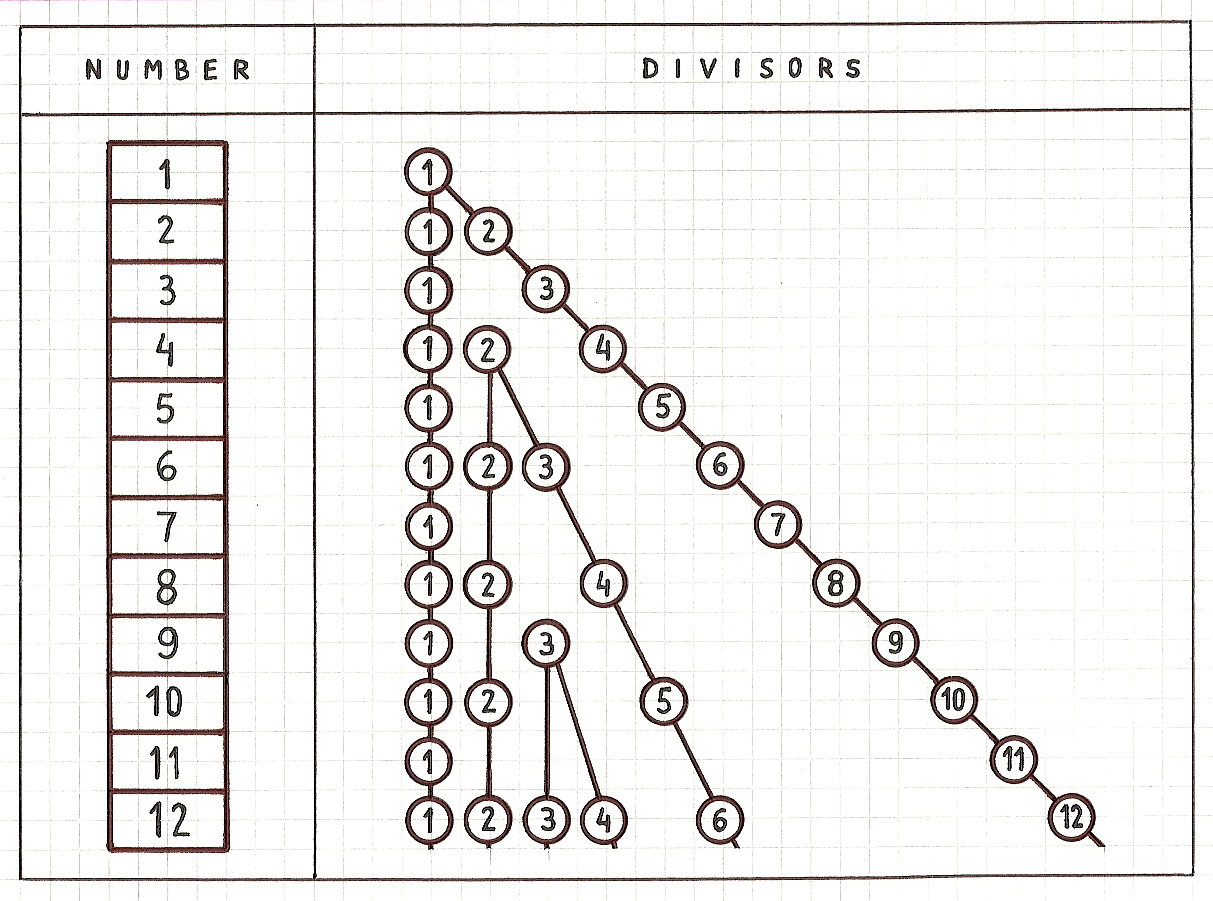
A193829 Irregular triangle read by rows in which row n lists the differences between consecutive divisors of n.

Original entry on oeis.org

1, 2, 1, 2, 4, 1, 1, 3, 6, 1, 2, 4, 2, 6, 1, 3, 5, 10, 1, 1, 1, 2, 6, 12, 1, 5, 7, 2, 2, 10, 1, 2, 4, 8, 16, 1, 1, 3, 3, 9, 18, 1, 2, 1, 5, 10, 2, 4, 14, 1, 9, 11, 22, 1, 1, 1, 2, 2, 4, 12, 4, 20, 1, 11, 13, 2, 6, 18, 1, 2, 3, 7, 14, 28, 1, 1, 2, 1, 4, 5, 15, 30
Offset: 2

Views

Author

Omar E. Pol, Aug 31 2011

Keywords

Comments

The sum of row n gives A000027(n-1). The product of row n gives A057449(n). Row n has length A032741(n). The final term of row n is A060681(n). It appears that the first term of row n is A057237(n).

Examples

			Written as a triangle:
1,
2,
1, 2,
4,
1, 1, 3,
6,
1, 2, 4,
2, 6,
1, 3, 5,
10,
1, 1, 1, 2, 6
		

Crossrefs

Cf. A060682 (distinct terms per row), A060680 (row minima), A060681 (row maxima).

Programs

  • Haskell
    import Data.List (genericIndex)
    a193829 n k = genericIndex a193829_tabf (n - 1) !! (k - 1)
    a193829_row n = genericIndex a193829_tabf (n - 1)
    a193829_tabf = zipWith (zipWith (-))
                           (map tail a027750_tabf') a027750_tabf'
    -- Reinhard Zumkeller, Jun 25 2015, Jun 23 2013
  • Mathematica
    Flatten[Table[Differences[Divisors[n]], {n, 2, 30}]] (* T. D. Noe, Aug 31 2011 *)

Formula

T(n,k) = A027750(n,k+1)-A027750(n,k). - R. J. Mathar, Sep 01 2011

A171462 Number of hands a bartender needs to have in order to win at the blind bartender's problem with n glasses in a cycle.

Original entry on oeis.org

0, 1, 2, 2, 4, 4, 6, 4, 6, 8, 10, 8, 12, 12, 12, 8, 16, 12, 18, 16, 18, 20, 22, 16, 20, 24, 18, 24, 28, 24, 30, 16, 30, 32, 30, 24, 36, 36, 36, 32, 40, 36, 42, 40, 36, 44, 46, 32, 42, 40, 48, 48, 52, 36, 50, 48, 54, 56, 58, 48, 60, 60, 54, 32, 60, 60, 66, 64, 66, 60, 70, 48, 72
Offset: 1

Views

Author

Richard Ehrenborg, Dec 09 2009

Keywords

Comments

For n greater than 1, the n-th entry is given by n*(1-1/p) where p is largest prime dividing n.

Examples

			a(4) = 2 since in the classical problem with 4 glasses on a tray, the blind bartender needs 2 hands.
		

References

  • W. T. Laaser and L. Ramshaw, Probing the Rotating Table, The Mathematical Gardner (edited by David A. Klarner), Prindle, Weber & Schmidt, Boston, Massachusetts, 1981, pages 285-307.

Crossrefs

Programs

  • Haskell
    a171462 n = div n p * (p - 1) where p = a006530 n
    -- Reinhard Zumkeller, Apr 06 2015
    
  • Mathematica
    {0}~Join~Array[# (1 - 1/FactorInteger[#][[-1, 1]]) &, 72, 2] (* Michael De Vlieger, Jul 08 2020 *)
  • PARI
    a(n) = {if (n == 1, return (0)); f = factor(n); p = f[#f~,1]; return (n * (p - 1)/p);} \\ Michel Marcus, Jun 09 2013
    
  • Python
    from sympy import primefactors
    def a(n): return 0 if n == 1 else n - n//(primefactors(n)[-1])
    print([a(n) for n in range(1, 74)]) # Michael S. Branicky, Apr 19 2021

Formula

Conjecture: n > 1: k=1..n: a(n) = -n*min(A191898(n, k)/k). Verified up to n=10000. - Mats Granvik, Apr 19 2021
a(n) = n - A052126(n) = n - n/A006530(n). - Antti Karttunen, Jan 03 2024
Previous Showing 11-20 of 70 results. Next